
Engineers specifying sealed housings for automotive electronics and outdoor devices often start with ePTFE protective vents, then ask a practical question: what else can do the same job? The answer is not “nothing.” Several materials and constructions can equalize pressure or block some contaminants. The useful distinction is which alternatives still hold an IP67, IP68, or IP69K rating after thermal cycling, oil mist, washdown, and years of field use—and which only look adequate on a datasheet.
This article compares common alternatives to ePTFE protective vents for automotive and electronics enclosures. The goal is to help design, validation, and purchasing teams choose by physics and test standards, not by slogan.
Why sealed housings still need a vent
A fully sealed box is not a finished design. Temperature change, altitude change, and heat from electronics create an internal-to-external pressure difference. Industry field data and enclosure studies consistently show that even a few kilopascals of cyclic pressure can fatigue gaskets, pull water past seals, and leave condensation on boards and optics.
A protective vent has two jobs at once:
- Let air and water vapor move so pressure stays near ambient.
- Block liquid water, dust, salt, and (in vehicles) oils and wash chemicals.
If a substitute only does one of those jobs, the housing either leaks, fogs, or needs heavier walls and thicker seals. That is the baseline against which every alternative should be judged.
How ePTFE vents actually work
Expanded polytetrafluoroethylene is made by stretching PTFE into a node-and-fibril network. Typical pore sizes used in protective vents are in the 0.1–0.5 μm range. Air molecules pass; a water droplet does not, because of pore size plus the low surface energy of the fluoropolymer. Oleophobic grades add resistance to motor oil, brake fluid, and alkaline cleaners.
When the membrane is built into an adhesive disk, weldable laminate, snap-fit cap, or threaded plug, and the housing is designed correctly, the assembly can support IP67, IP68, and—on selected constructions—IP69K under IEC 60529 and ISO 20653. Temperature capability of the polymer itself is very wide; practical vent assemblies for vehicles and electronics commonly target about −40 °C to +150 °C or +160 °C, depending on housing plastic, adhesive, and mounting method.
That combination—high airflow at low differential pressure, liquid barrier, chemical inertness—is why ePTFE became the default in ECUs, sensors, lighting, and many battery or inverter housings. It is also why alternatives exist: cost, thickness, welding process, or a lower IP target can justify a different material.
Microporous polyethylene (PE) membranes
Microporous PE is the most common cost-down candidate. Airflow can be high, parts are easy to die-cut, and unit price is usually lower than ePTFE.
Limits show up quickly in automotive and outdoor electronics:
- Temperature ceiling is typically around −40 °C to +80 °C. Under-hood, near inverters, or in dark outdoor boxes that soak in sun, PE softens or ages.
- Chemical and oil resistance is moderate. Oil mist wets the pores and cuts airflow.
- Oleophobicity is poor unless extra coatings are added, and those coatings wear.
- Long-term durability in thermal cycling is usually measured in a few years, not a vehicle life.
- Realistic IP support is often IP65–IP67, not sustained IP68/IP69K after wash and oil exposure.
PE can be acceptable for indoor consumer electronics, some lighting interiors, or low-temperature outdoor boxes with mild splash. It is a weak substitute for under-hood ECUs, chassis electronics, and high-pressure wash zones.
Sintered PTFE
Sintered (porous) PTFE is not the same as expanded PTFE. It is a denser, more rigid porous structure made by sintering PTFE particles. Chemical resistance and temperature range are excellent—comparable to ePTFE on paper.
Trade-offs:
- Airflow per unit area is usually lower. Equalizing a given enclosure volume may need a larger vent face or a higher pressure drop.
- Oleophobicity is good but often not as tunable as treated ePTFE laminates.
- The part is thicker and less flexible, which complicates adhesive and low-profile designs.
- Typical system ratings land in the IP66–IP68 band. IP69K is possible only with careful mechanical shielding.
Sintered PTFE is a serious alternative when chemical attack and heat dominate, and when the designer can give the vent more area. It is less attractive when the housing is small, the thermal cycle is fast, or the airflow target is high at a few kilopascals.
Sintered metal filters and bronze breathers
Sintered stainless steel or bronze discs look robust. Dust blocking can be excellent, temperature range is wide, and mechanical abuse resistance is high.
They fail the dual-job test in many electronics housings:
- Airflow is moderate to low unless the pore size is opened—then water resistance falls.
- Metals are not oleophobic. Oils and road film clog pores.
- Water can wet the metal path more easily than a hydrophobic fluoropolymer membrane.
- Weight and cost are high for the airflow delivered.
- Typical IP support is IP65–IP67, not a reliable IP69K liquid barrier without extra labyrinth geometry.
Metal filters still have a place on large industrial cabinets, some hydraulic or gearbox breathers, and high-heat mechanical assemblies. For compact automotive electronics and sealed outdoor PCBs, they usually force a compromise on either breathability or waterproofing.
Coated nonwovens and fabric vents
Polyester or polypropylene nonwovens with hydrophobic coatings are inexpensive and can move a lot of air. They are common in packaging and light consumer devices.
For automotive and industrial electronics they age poorly:
- Coatings wear under UV, abrasion, and wash chemicals.
- Waterproof rating is typically modest (often IP54–IP65 class behavior).
- Temperature and chemical windows are narrower than fluoropolymers.
- Field life is often two to four years in outdoor duty.
Use them where the enclosure is not expected to see immersion, pressure wash, or oil. Do not treat them as a drop-in for an ePTFE automotive vent.
Open paths, umbrella valves, desiccants, and potting
These are not membrane alternatives so much as different design strategies.
- Tortuous-path or labyrinth holes equalize pressure but do not stop fine dust, driven rain, or insects once the path is wet or dirty.
- Rubber umbrella valves fatigue in cold/heat cycles and give little continuous vapor transmission.
- Desiccants absorb moisture for a limited time and do nothing for pressure. They saturate.
- Potting or conformal coating can protect a board, but it adds weight, blocks repair, and still leaves the housing seals exposed to pressure if the box is otherwise sealed.
These methods can supplement a vent. They rarely replace a properly specified protective membrane when IP67 and above must survive the life of the product.
What the comparison looks like in practice
| Material / approach | Typical IP support | Airflow | Oil / chemical behavior | Practical temperature window | Best-fit use |
|---|---|---|---|---|---|
| ePTFE microporous membrane | IP67–IP69K (design-dependent) | High at low ΔP | Hydrophobic and oleophobic grades available | Very wide; assemblies often −40 to +150/160 °C | ECU, sensor, radar, lighting, NEV electronics, outdoor sealed boxes |
| Microporous PE | IP65–IP67 | High | Weak oil resistance | Roughly −40 to +80 °C | Cost-sensitive, mild environments |
| Sintered PTFE | IP66–IP68 | Moderate | Excellent chemical resistance | Comparable to PTFE, assembly-limited | Harsh chemicals, when more vent area is available |
| Sintered metal | IP65–IP67 | Moderate to low | Poor oleophobicity; clogging risk | Very high | Industrial / mechanical breathers |
| Coated nonwoven | IP54–IP65 | High | Coating-dependent, wears | Limited | Light-duty or short-life products |
| Labyrinth / open path | Not a true liquid barrier | High | None | N/A | Not a substitute where IP67+ is required |
Ratings in the table are typical industrial ranges under IEC 60529 / ISO 20653 thinking, not a guarantee for any single part. Final IP is always a system result: membrane + housing geometry + gasket + installation + test method.
Automotive electronics: where alternatives usually break
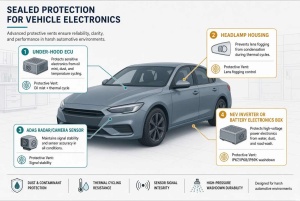
Under-hood and chassis modules see oil mist, salt, stone spray, −40 °C starts, and soak temperatures above 125 °C. Lighting sees rapid heat-up and cool-down plus condensation on lenses. ADAS radar and camera housings cannot tolerate fog on the optical path or pressure that shifts a seal.
In those conditions:
- PE membranes lose airflow after oil contact and heat aging.
- Metal breathers load with film and dust.
- Unvented or labyrinth-only housings pass an initial spray test, then fail after thermal cycles because the gasket has been pumped.
ePTFE adhesive vents, weldable disks, snap-fit caps, and threaded plugs remain the usual specification because they keep airflow after oil exposure and still support the IP rating the validation plan requires. Sintered PTFE is the closest fluoropolymer alternative when the designer can enlarge the vent area.
Electronics and outdoor enclosures: a more mixed picture
Not every electronics box needs IP69K. A telecom or outdoor IoT enclosure that sees rain and dust, but not pressure wash or engine oil, can sometimes use a larger PE vent or a sintered PTFE plug if temperature stays moderate and the service life target is shorter.
The decision should still be quantitative:
- Enclosure free volume and worst-case dT/dt (how fast pressure builds).
- Required airflow at a stated ΔP (for example ml/min/cm² at 7 kPa).
- Water entry pressure and the exact IP test (immersion depth/time, IPX9K jet).
- Fluid list: water only, or oils, coolants, detergents.
- Housing material and process: adhesive, ultrasonic weld, snap, or thread.
- Life target and validation: thermal shock, salt fog, vibration, UV.
If the answers point to IP68/IP69K, oil contact, and 10-year outdoor or vehicle life, most non-ePTFE options drop out. If the answers point to IP65, indoor-outdoor splash, and a short product cycle, an alternative can be the correct engineering choice.
How to specify without buying the wrong “equivalent”
Ask suppliers for the same data set, not a marketing IP logo:
- Air permeability at a defined pressure (state the area and the kPa or mbar).
- Water entry pressure and hold time.
- Oil rating or oleophobic grade, if the part will see automotive fluids.
- Temperature range of the full assembly, not only the membrane polymer.
- Test reports against IEC 60529 and, for vehicles, ISO 20653 / IATF process control.
- Installation limits: minimum weld energy, adhesive surface energy, recommended hole geometry, and whether the vent needs a shield wall for IPX9K.
A part that is “IP67” on a clean new membrane can fail after oil fog or after the adhesive edge lifts. That is an assembly problem, not a reason to abandon the material class.
Where Spider(Xiamen) Technology Co., Ltd fits this decision
Spider(Xiamen) Technology Co., Ltd has focused on ePTFE membranes and high-performance protective breathable products since 2016—more than ten years on this material family. Protection levels of finished vent constructions can reach IP67, IP68, and IP69K when the housing and installation match the grade. Applications cover electronics, automotive, new energy, outdoor equipment, and medical devices.
Quality systems include ISO9001 and IATF16949. Supporting documentation can include SGS, CE, UL, PFOA-Free, RoHS, and REACH reports. Products are exported to Europe, the United States, Germany, Korea, Japan, India, Russia, Turkey, and other markets, with customized venting work for more than 1,000 enterprises.
The company’s stated principle is “Integrity builds quality, innovation leads the future.” A polymer-materials R&D group of master’s- and doctoral-level engineers invests 5%–20% of annual revenue in new product work. That is relevant here only because alternative selection is a materials problem: pore structure, oleophobic treatment, laminate stack, and housing interface have to be tuned together. The same team can also say when ePTFE is not necessary, which is the honest use of alternatives.
For application review—airflow target, IP test plan, adhesive vs weld vs snap-fit, or a side-by-side against PE or sintered PTFE—contact weitaiyan@spider-amoy.com.
Practical takeaway
“ePTFE protective vent alternatives” is a valid search. Microporous PE, sintered PTFE, sintered metal, and coated fabrics all work in defined windows. They are not interchangeable with ePTFE when the housing must keep breathing after oil, heat, immersion, or high-pressure wash for the life of an automotive or outdoor electronic product.
Choose the alternative when the environment, IP target, and life target actually fit that material. Choose ePTFE when the enclosure must do both jobs at once—pressure equalization and a durable liquid/dust barrier—without adding mass, potting, or oversized seals.
By SST R&D Engineering Team, Spider(Xiamen) Technology Co., Ltd.