
How ePTFE Works: Pore Size, WEP, and Airflow
A protective vent is useful only when three numbers work together: how large the pores are, how much liquid pressure the membrane can hold back, and how fast air can move through the same structure. Engineers often receive a datasheet with an IP rating and an airflow figure and treat them as independent. They are not. Pore geometry sets both water-entry pressure (WEP) and air permeability. If you change one without checking the other, the enclosure either breathes too slowly or wets too easily.
What an ePTFE membrane actually is
ePTFE starts as PTFE resin. The resin is extruded into a film and then stretched under controlled temperature and rate. Stretching pulls the polymer into a node-and-fibril network: solid nodes connected by fine fibrils, with empty space between them.
That empty space is the pore system. Air and water vapor can pass through it. Liquid water and most dust particles cannot, provided the pores stay below a critical size and the surface stays hydrophobic. The chemistry is still PTFE—low surface energy, wide temperature range, strong chemical resistance—so the barrier is not a coating that wears off in the first wash. The coating, when present, is usually an oleophobic finish added so oils and coolants do not wet the pores.
Pore size, porosity, thickness, and lamination (polyester or polypropylene support) are process variables. They are the levers behind the WEP and airflow numbers on a vent drawing.
Pore size: the length that controls both barrier and flow
“Pore size” on a vent membrane is not one hole diameter. It is a distribution.
- Mean-flow pore size describes the typical path that carries most of the gas.
- The largest pores control liquid breakthrough. Water finds the weakest path first.
- Porosity and tortuosity describe how much open volume exists and how twisted the path is. Two membranes with the same mean pore size can differ in airflow if one is thicker or more tortuous.
Protective-vent grades used on sealed electronics commonly sit in the sub-micron to low-micron range. That is far smaller than a raindrop (millimetres) and smaller than most airborne dust, but large enough for nitrogen, oxygen, and water-vapor molecules.
A single nominal pore size is not a specification by itself. Ask for the measurement method (bubble point, capillary flow porometry, or image analysis) and whether the value is mean-flow or maximum pore. WEP is often a more honest liquid-barrier number than a pore-size callout, because WEP is measured with the liquid you care about—or at least with water under a defined hold time.
Water entry pressure: why liquid water stops and air does not
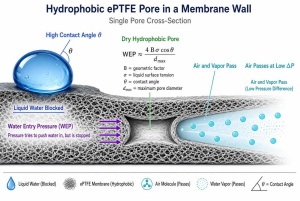
Water entry pressure is the minimum pressure difference that forces liquid water through the membrane. In vent datasheets it is often written as water pressure resistance, for example in kPa held for 60 seconds.
The governing idea is capillary pressure. For a pore of effective radius r:
ΔP ≈ − (2 × σ × cosθ) / r
Or, with a shape factor B and maximum pore diameter d_max:
WEP ≈ (4 × B × σ × cosθ) / d_max
Where:
- σ = liquid surface tension
- θ = contact angle on the pore wall
- r = effective pore radius
- d_max = largest pore diameter
- B = pore-shape factor (B = 1 for an ideal cylindrical pore)
PTFE is hydrophobic. Water beads; θ is high; cosθ works against penetration. Combined with a small d_max, that produces a WEP high enough for splash, spray, and many immersion profiles. Air has no comparable capillary barrier in a dry hydrophobic pore, so gas still moves at a few kilopascals of differential.
Three practical consequences follow:
- WEP is set by the largest pores, not the average. A few oversized defects will drop the rating even if mean pore size looks tight.
- WEP is liquid-specific. Oil, coolant, detergent, or alcohol has a lower surface tension than water. An oleophobic grade exists because a water-only WEP does not predict oil wetting.
- WEP is not the same as an IP rating. IP68 is tested on the installed vent and housing, at an agreed depth and time. A membrane WEP of 50 kPa / 60 s is a material screen; the pack test still has to be run.
Published adhesive-vent grades from Spider (Xiamen) Technology Co., Ltd. typically fall in a WEP window of about 30–100 kPa for 60 s, paired with IP67 or IP68 (and IP69K on selected constructions). Those figures are grade- and install-dependent, not a universal constant.
Airflow: how fast the enclosure can equalize
Air permeability is the volume of air that crosses a unit area at a stated pressure drop. A common lab condition for these membranes is ml/min·cm² at 7 kPa (70 mbar). Always keep the ΔP in the number. Airflow at 7 kPa is not airflow at 1 kPa; the relationship is not something you can scale by guesswork if the membrane is already near a nonlinear regime.
Airflow rises when:
- pores are larger or more numerous
- the membrane is thinner or less tortuous
- the open area of the finished vent is larger
- the cap or weld does not shadow the membrane
Airflow falls when the membrane is tighter, laminated to a dense support, covered by a poorly designed cap, or partially wetted or clogged by oil mist and mud.
For a sealed pack or electronic box, the design question is not “maximum airflow.” It is: given free-air volume and the fastest realistic temperature or altitude ramp, how much membrane area at this permeability keeps peak ΔP below the gasket and cover limit. Too little airflow leaves the housing acting like a weak pressure vessel. Too much airflow, bought by opening the pore structure, usually costs WEP.
Typical adhesive ePTFE grades used in outdoor and automotive electronics sit roughly in the 300–2500 ml/min·cm² @ 7 kPa band, with the high-flow end generally carrying a lower WEP. That band is a selection window, not a promise that every part in a catalog occupies both extremes at once.
The trade-off that every grade is negotiating
Hold chemistry fixed. Then:
- Smaller maximum pores → higher WEP, lower airflow.
- Larger or more open pores → higher airflow, lower WEP.
- Support layers and oleophobic treatments shift both numbers and change temperature and chemical limits.
There is no free increment. A drawing that asks for “highest IP and highest flow in the smallest hole” is asking the membrane to occupy two corners of that curve at once. The honest answer is to fix the constraint that fails first.
- Immersion or high-pressure wash dominates → start from WEP and IP protocol, then size area to recover airflow.
- Fast thermal ramps or large free volume dominate → start from airflow and ΔP, then check that WEP still covers splash and the agreed immersion test.
- Oil-cooled motors or underbody mist dominate → add oleophobicity to the requirement list; water WEP alone will not describe field life.
Thickness and lamination are part of the same curve. A support layer that survives ultrasonic welding or a threaded cap can reduce effective permeability even when the bare film looks open. Specify the finished part, not the film in isolation.
How to read a datasheet without mixing units
Treat these as a minimum set:
- Air permeability, with area basis and ΔP (ml/min·cm² @ 7 kPa, or an equivalent you can convert).
- WEP, with hold time (kPa / 60 s is common).
- IP protocol for the assembled vent: depth, duration, and whether the part was pre-conditioned by heat, vibration, or thermal shock.
- Temperature range of membrane plus carrier.
- Oleophobic rating if oils or surfactants are present.
- Construction: 100% ePTFE, or ePTFE plus polyester / PP support.
Do not compare a Gurley-second textile number with a 7 kPa vent number and call them the same airflow. Do not treat bubble-point in isopropyl alcohol as water WEP. Do not assume IP68 on a blanked housing still holds after a high-flow membrane is welded in.
Prototype the vent in the production location. A membrane that meets WEP on a fixture can be starved by a cap, or over-exposed to a jet, once it is on the pack wall.
Where this sits in real housings
The same three parameters show up in EV battery covers, ECU and inverter boxes, lamps, outdoor electronics, and packaging vents. The duty cycle changes the target point on the curve; the physics does not.
Spider (Xiamen) Technology Co., Ltd. has worked on ePTFE membranes and protective vents since 2016. A polymer R&D group that includes master’s- and doctoral-level engineers puts 5%–20% of annual revenue into membrane and process development. Production runs under ISO 9001 and IATF 16949. Third-party reports covering SGS, CE, UL, PFOA-Free, RoHS, and REACH can be supplied where a customer’s PPAP or incoming inspection requires them. Parts from this line have been supplied to customers in Europe, the United States, Germany, Korea, Japan, India, Russia, Turkey, and other markets.
The internal line is “integrity builds quality; innovation leads the future.” In membrane work that means publishing WEP and airflow on the same grade, under the same test conditions, instead of selling an IP logo as if pore size did not exist.
For grade selection against a pack volume, ΔP limit, or wash-down spec, contact weitaiyan@spider-amoy.com.
By SST R&D Engineering Team, Spider(Xiamen) Technology Co., Ltd.