
A sealed electronic housing is built to keep water, dust, and salt out. That same seal traps a volume of air. When temperature or altitude changes, that air expands or contracts. If the air has no controlled path, the housing sees over-pressure or vacuum. Gaskets creep, lids flex, moist air is pulled through imperfect joints, and water vapor condenses on the coldest board or connector.
A protective vent is the component that breaks that contradiction. It lets gas and water vapor move while blocking liquid water and particles, so the enclosure can keep a high ingress-protection rating and still equalize pressure in daily use.
What a protective vent is
In engineering use, a protective vent is a small assembly built around a microporous membrane—most often expanded polytetrafluoroethylene (ePTFE)—held in a plastic or metal body, an adhesive patch, a weldable disc, or a snap-in cap.
The membrane contains a node-and-fibril network with a large population of sub-micron pores. Air molecules and water vapor pass through those pores. Liquid water does not, provided the water-entry pressure of the membrane and the housing geometry stay above the spray or immersion load the product is designed for. Dust and most aerosols are stopped by the same pore scale.
The vent is not a hole, a slit, or a “waterproof speaker mesh” by itself. It is a sized airflow path with a defined water-entry pressure, a mounting method that does not leak around the membrane, and—when the duty requires it—oleophobic treatment, a spray shield, or a coalescing stage.
Typical finished-housing targets in electronics and automotive work are IP67 or IP68, with IP69K specified where high-pressure wash-down is part of production or service. Those ratings describe the enclosure with the vent installed. They are not a standalone material grade.
Why a fully sealed box still fails
Hermetic sealing looks conservative on a drawing. On a vehicle, a lamp, an outdoor controller, or a handheld device it creates four recurring problems.
Pressure load on seals and walls. A temperature rise at fixed volume raises internal pressure; cooling or a climb in altitude lowers it. Unvented differentials of tens to more than a hundred millibars are routine on real housings. Repeated load loosens gasket compression and can oil-can thin covers.
Vacuum-driven ingress. When internal pressure is below ambient, water and contaminated air are pulled toward every imperfect interface—connector seals, cable glands, lid joints—even if those joints passed a static spray test.
Condensation without a visible leak. Humid air that entered at assembly, service, or during a vacuum event stays inside. When a wall or a metal boss is colder than the internal air, vapor condenses on circuitry. Corrosion and insulation-resistance drop follow. A vent that transmits vapor as the box warms reduces that trapped humidity. Liquid water is still rejected.
Gas and heat with nowhere to go. Some assemblies outgas, some lamps and power stages heat a trapped air volume, some battery or motor housings generate modest gas in normal use. A sealed box stores that pressure. A protective vent is the everyday breathing path. Emergency degassing on a battery pack is a different, much larger flow event and needs its own hardware.
How the membrane does two jobs at once
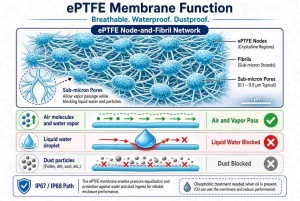
Pore diameter sits between the size of a gas molecule and the size of a liquid droplet. That is the whole trick.
Air and vapor move under a small differential, so the housing ΔP stays inside the seal’s working range. Water sees a hydrophobic surface and a high entry pressure, so it beads and stays outside. For housings near oil, fuel, or wash chemicals, an oleophobic surface is required as well: oils have lower surface tension than water and will wet a hydrophobic-only film, filling pores and cutting airflow even though the part still “looks dry.”
Useful selection numbers are not slogans. They are airflow at a stated differential (for example liters per hour at 7–10 mbar), water-entry pressure, operating temperature, chemical list, and the IP protocol the finished housing must pass. Higher airflow usually means more open area or a more open membrane; higher water-entry pressure usually means a tighter structure. The correct point is set by free volume, worst-case ΔT, and the maximum ΔP the gasket can live with.
Where sealed electronics actually use them
The duty is the same idea in different boxes:
- Outdoor and industrial electronics: controllers, sensors, junction boxes, lighting drivers.
- Automotive electronics: ECU, inverter, onboard charger, radar and camera modules, lamps.
- New-energy housings: battery packs (everyday equalization, not thermal-runaway dump), oil-cooled motors, e-axle and gearbox breathers with an oil-mist stack.
- Medical and handheld devices: enclosures that must survive wipe-down or incidental splash without pumping air through the seam.
- Outdoor equipment: meters, radios, and packs that see rain, dust, and altitude in the same week.
In each case the vent is there so the designer can keep the seal and still let the box breathe.
What goes wrong when the vent is missing or the wrong type
From housing work, the pattern is consistent. An unvented or undersized box shows seal weep after seasonal cycling. Condensate appears on the coldest internal surface after a humid day and a cold night. Dust films collect near joints that only move under vacuum. A hydrophobic-only vent on an oil-cooled motor or gearbox loses airflow as mist blinds the membrane. A vent aimed at standing water or high-pressure spray wets from the outside. A membrane that cannot survive the plant leak-test vacuum fails on the line after it was specified correctly for the field.
None of these require a dramatic fault. They are life-of-product issues on a sealed volume that still lives in weather, wash, and thermal cycling.
How to specify a protective vent
Start from the enclosure.
Measure or estimate free air volume and the fastest realistic temperature ramp. Convert that to an allowable peak ΔP. Size airflow so the vent holds ΔP inside that limit after the environment the part will see—not only when the coupon is new.
Lock IP and chemistry to the real duty: rain, fording, IPX9K wash, oils, coolants, cleaning agents. Choose the interface the plant can repeat: adhesive, weld, snap-fit, or screw-in. Place the vent where it will not sit in a water pocket and where spray does not hit the membrane face. Validate on the real housing: thermal cycle, immersion or spray to the target IP, vibration, and, for oil duty, airflow after mist exposure.
A coupon datasheet is necessary. It is not the housing test.
Spider(Xiamen) Technology Co., Ltd has worked on ePTFE membranes and protective venting components since 2016—more than ten years on waterproof-breathable structures for electronics, automotive, new-energy, outdoor, and medical housings. The polymer-materials group includes master’s- and doctoral-level engineers and allocates 5%–20% of annual revenue to product and process development. Production runs under ISO 9001 and IATF 16949. Third-party documentation can include SGS, CE, UL, PFOA-Free, RoHS, and REACH reports where required. Protective ratings available on finished vent assemblies include IP67, IP68, and IP69K, subject to housing design and test protocol. Products have been supplied to customers in Europe, the United States, Germany, Korea, Japan, India, Russia, Turkey, and other markets, supporting customized venting for more than 1,000 enterprises.
The practical question is simple: can this sealed box equalize pressure and shed vapor without taking in liquid or dust for the life of the product. That is what a protective vent is for. The company line behind that work is integrity builds quality, innovation leads the future.
For airflow and water-entry data on a specific housing, application review, or a custom ePTFE vent construction, contact weitaiyan@spider-amoy.com.
By SST R&D Engineering Team, Spider(Xiamen) Technology Co., Ltd.