
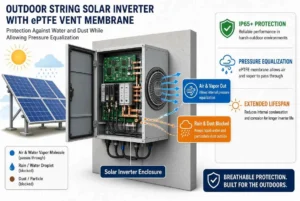
A sealed solar inverter or outdoor electrical enclosure is not a closed thermodynamic system. It is a volume of air that heats, cools, expands, and contracts every day. When that volume has no controlled path for air and water vapor, two failures appear together: seals take cyclic mechanical load, and internal surfaces drop below the dew point. An ePTFE vent membrane is not a marketing add-on. It is the component that keeps pressure near ambient and lets moisture vapor leave without opening a path for rain, dust, or washdown water.
This article explains the physics, the limits of IP ratings, how an ePTFE membrane actually works, and what engineers should specify for string inverters, microinverters, combiner boxes, and outdoor control housings.
Why sealed outdoor electronics still fail
IP65 or IP66 on an inverter datasheet answers one question: can liquid water and dust enter through joints under a defined test? It does not answer whether the enclosure can survive years of temperature cycling without the gasket leaking, or whether boards will see condensed water at dawn.
Typical field conditions for a roof- or ground-mounted inverter:
- Daytime internal air well above ambient because of conversion losses and solar load on the housing.
- Rapid cooling at sunset, during a storm, or when a cloud bank arrives.
- Relative humidity that is often high at night, especially near the ground or in coastal and tropical sites.
- Occasional pressure change from altitude (shipping, mountain sites) or from a sudden cold rain on a hot enclosure.
Warm air inside a sealed box holds more water vapor. When the housing walls and heat sinks cool, that vapor condenses on the coldest surfaces—PCB edges, busbars, terminals, optical sensors, and the inner face of the cover. Condensate is more damaging than brief rain on the outside because it stays on the metal and dielectric surfaces. Corrosion, tracking, and intermittent insulation faults often show up first thing in the morning and disappear after the unit warms up. That pattern is a humidity problem, not a random component defect.
At the same time, the ideal gas law is not optional. A 40–60 K temperature swing in a rigid enclosure produces a pressure swing of tens of millibar if air cannot move. Repeated load on the gasket, cover screws, and cable glands is how a “sealed” box eventually develops a leak path. Once that path exists, liquid water and dust follow the pressure gradient inward.
What an ePTFE vent membrane actually does
Expanded polytetrafluoroethylene (ePTFE) is a microporous fluoropolymer. The pores are large enough for air and water-vapor molecules to pass, and small enough—combined with the low surface energy of PTFE—to block liquid water and most airborne particles.
In practice the membrane does three jobs at once:
- Pressure equalization. Air flows in both directions so internal pressure stays close to ambient. Seal stress drops. Housing walls are less likely to dish or crack.
- Water-vapor transport. Moisture that entered with air, or that desorbed from plastics and potting, can leave when the interior is warmer and drier relative to the outside. The enclosure can approach equilibrium instead of trapping humidity.
- Barrier. Liquid water, dust, and, on oleophobic grades, low-surface-tension fluids stay outside. That is why a vented enclosure can still be designed and tested to IP67, IP68, or, on selected constructions, IP69K.
The membrane is not a fan and not a drain. It does not replace thermal design. It does not remove the need for a competent gasket. It removes the false choice between “fully sealed and overstressed” and “open hole and contaminated.”
Pressure first, then condensation
Equalizing pressure is the prerequisite. If the gasket is cycling under load, vapor control is secondary because the box will eventually leak liquid water.
Industry temperature-cycling work on junction boxes and similar housings shows the pattern clearly: an unvented sealed box builds a pressure differential; after repeated cycles the seal creeps or lifts; humidity then tracks the leak. A box with a correctly sized ePTFE vent stays near zero differential, and internal absolute humidity and dew point stay lower because vapor can leave while the unit is hot.
For inverter engineers this has a direct design consequence. Do not oversize gasket compression or add extra fasteners to “fight” pressure. Size the vent for the free volume and the expected dT/dt, then keep the mechanical seal at a realistic compression set. The vent is cheaper than a failed field unit and cheaper than a heavier housing.
IP ratings: use them correctly
IEC 60529 (and ISO 20653 for IP69K) classifies ingress of solids and liquids. Common targets for outdoor power electronics:
- IP65 / IP66: dust-tight plus water jets. Typical for many string-inverter housings.
- IP67: temporary immersion (commonly 1 m, 30 min—confirm the exact test on the vent and on the finished enclosure).
- IP68: continuous immersion under conditions defined by the manufacturer.
- IP69K: high-pressure, high-temperature spray. Relevant where equipment is washed down, not for every rooftop inverter.
Two points are often missed.
First, the rating is for the assembled enclosure, not for the membrane coupon alone. Adhesive area, weld quality, thread seal, and cover orientation all matter.
Second, IP says nothing about internal relative humidity or dew-point margin. An IP66 inverter can still condense. Specify the vent for both the IP test you must pass and the vapor transport you need in the climate where the product will live.
Where vents belong on solar and outdoor equipment
Typical locations that benefit from an ePTFE vent membrane:
- String and microinverters
- Combiner and recombiner boxes
- Tracker controllers and motor housings
- Monitoring and communication enclosures
- Outdoor ESS and hybrid inverter cabinets (day-to-day pressure and humidity; over-pressure relief for fault gases is a separate design problem)
- Any sealed outdoor box that sees sun load, rain, and daily thermal cycling
Placement matters. Prefer a position that is not a standing-water pocket. Avoid aiming a jet directly at an adhesive vent during IPX6 / IPX9K tests unless the part and the installation method were validated for that orientation. For large cabinets, more than one vent can shorten the equalization time constant; two vents also give a path if one face is temporarily wetted.
How to specify the membrane, not just “add a vent”
A useful specification is more than a catalog part number. At minimum, define:
- Target IP level of the finished enclosure and the test orientation.
- Free internal volume and worst-case temperature ramp (startup in sun, shutdown in rain, cold-climate night drop).
- Airflow or pressure-equalization time you will accept (often expressed as air permeability at a stated differential, e.g. ml/min/cm² at 7 kPa). Higher permeability equalizes faster; water-entry pressure usually falls as permeability rises. That trade-off must be chosen, not ignored.
- Hydrophobic versus oleophobic. Rooftop rain and dust often need hydrophobic performance. Sites with oils, agricultural spray, or detergents need oleophobic treatment so the membrane does not wet out and lose airflow.
- Temperature range of housing and process. Weldable constructions see a short thermal spike during assembly; the membrane and support layer must survive that plus field temperature.
- Installation method: adhesive (peel-and-stick, interior or exterior), snap-in, threaded plastic or metal, or weldable membrane for ultrasonic or thermal staking.
- Chemical and regulatory pack: RoHS, REACH, PFOA-free, and any UL or customer-specific flammability or aging requirement.
Do not copy a lighting-fixture vent into a high-power inverter without checking airflow versus volume. Do not assume a vent that passed IP67 on a small camera housing will equalize a 50-liter cabinet in an acceptable time.
Materials and durability that actually last outdoors
ePTFE is chemically inert across the temperature and chemistry range of most outdoor electronics. The weak points in the field are usually not the polymer itself. They are adhesive aging under UV and heat, plastic housing creep, thread sealant, and contamination that blocks the outer face.
Good practice:
- Use UV-stable housings and adhesives when the vent sits on an exterior wall.
- Keep the outer face drainable. A permanently wetted membrane still blocks liquid water but airflow falls.
- Qualify the stack (membrane + support + adhesive or weld) with the same humidity-heat and thermal-cycle profiles you use on the inverter (for example damp heat and temperature cycling consistent with IEC environmental methods used on PV electronics). Third-party reports (SGS and similar) on the membrane are useful; they do not replace enclosure-level tests.
- Treat oleophobic performance as a measured property, not a label. Oils and surfactants change wetting behavior.
Spider(Xiamen) Technology Co., Ltd has worked only in this material family since 2016: ePTFE membranes and protective breathable parts for electronics, vehicles, new energy, outdoor equipment, and related industrial housings. Protection levels of IP67, IP68, and IP69K are achieved on defined constructions and installations—not as a blanket claim for every cut part. Quality systems are ISO9001 and IATF16949. SGS, CE, UL, PFOA-free, RoHS, and REACH documentation can be provided against the grade you are evaluating. A polymer R&D team at master’s and doctoral level puts 5%–20% of annual revenue into membrane structure, oleophobic treatment, and process control. That is the only way pore size, airflow, and water-entry pressure stay in spec from lot to lot.
The working rule inside the company is straightforward: integrity builds quality, innovation leads the future. For an inverter OEM that means a vent that still breathes after heat, UV, and rain—not a part that looks correct on day one.
Practical integration notes for design and process
- Decide vent location before the tool is cut. A flat, clean land for adhesive or a molded boss for snap-in or thread saves rework.
- For adhesive vents, control surface energy, dust, and bond pressure. A wrinkled or contaminated bond line is a leak, not a vent problem.
- For threaded vents, specify torque and thread seal. Over-torque crushes the membrane support; under-torque leaks around the thread.
- For weldable membranes, lock welding energy and time so the ePTFE is not closed or delaminated.
- Record the vent part number in the BOM with the airflow grade. “Generic ePTFE sticker” is how mixed lots appear in the field.
- In service manuals, tell technicians not to paint over the vent and not to blast it with a pressure washer at point-blank range unless that construction was tested for IP69K.
When a vent is not enough
A membrane vent will not fix an undersized heat sink, a cover that ponds water, a cable gland that was never torqued, or an enclosure that is already full of hygroscopic dust. It will not replace a pressure-relief device sized for thermal runaway gas in a battery cabinet. Use it for the job it has: keep ΔP small and give water vapor a way out while liquid water stays out.
If internal RH still stays high after a correctly sized vent is fitted, look at desiccant only as a seasonal buffer, improve drain geometry, and check whether warm, wet air is being pulled in through a poor secondary seal. The vent should not be asked to compensate for those defects.
How to move from datasheet to a working part
Send the enclosure volume, target IP test, climate, mounting orientation, and preferred assembly method. A membrane supplier that has spent a decade on ePTFE can answer with airflow grade, water-entry pressure, hydrophobic or oleophobic finish, and a construction (adhesive, snap-in, threaded, or weldable) that fits the tool and the line.
Spider(Xiamen) Technology Co., Ltd supplies these constructions to manufacturers in Europe, the United States, Germany, Korea, Japan, India, Russia, Turkey, and other markets, and has supported customized protective venting for more than 1,000 enterprises. For application review, samples, or a custom OD/ID and permeability window, contact weitaiyan@spider-amoy.com.
The goal is not a longer brochure. It is an inverter or outdoor enclosure that still meets its IP rating after years of sun and rain, and whose boards stay above the dew point at 5 a.m.
By SST R&D Engineering Team, Spider(Xiamen) Technology Co., Ltd.