
Engineers and product developers working with electronics enclosures, electric vehicle systems, automotive components, and outdoor equipment often face a difficult choice: how to protect sensitive internals from water, dust, and contaminants while allowing necessary air exchange and pressure equalization. Traditional materials have long been used for sealing and venting, but they frequently force unacceptable trade-offs. Expanded polytetrafluoroethylene (ePTFE) membranes have emerged as a clearly superior solution in demanding applications because they deliver an exceptional balance of high breathability and robust liquid barrier performance that conventional options struggle to match.
What Traditional Materials Are Commonly Used for Protection?
For decades, designers have relied on several conventional approaches to achieve waterproofing and environmental protection:
- Dense rubber gaskets, O-rings, and silicone seals provide excellent initial liquid sealing but offer zero breathability.
- Metal vents or mesh filters combined with basic screens deliver mechanical durability but are prone to corrosion and offer limited, inconsistent airflow.
- Non-expanded or standard polymer membranes (such as certain PP or PE materials) provide some level of barrier at lower cost but suffer from narrower temperature tolerance and faster degradation.
- Foam-based or simple non-woven vents are inexpensive and easy to install yet clog easily, lose performance over time, and provide only marginal protection in harsh conditions.
Each of these approaches solves part of the problem while creating others, particularly around pressure buildup, condensation, and long-term reliability.
Key Limitations of Traditional Materials
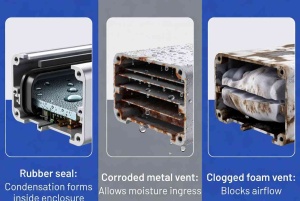
Traditional solutions commonly exhibit one or more of the following shortcomings in real-world use:
- Poor breathability-to-barrier balance: Many seals block water effectively but trap air and moisture vapor inside enclosures. Temperature cycling and altitude changes then cause pressure differentials that stress seals, lead to condensation, or force designers to add active fans or pressure relief valves that introduce new failure points.
- Limited chemical and thermal resistance: Rubber and many polymer materials degrade when exposed to oils, solvents, UV radiation, or wide temperature swings common in automotive, EV, and outdoor environments.
- Inconsistent long-term performance: Basic membranes and foam vents often clog with dust or lose hydrophobicity over time, reducing both airflow and protection levels.
- Difficulty achieving high IP ratings reliably: While some traditional vents claim high protection ratings in lab conditions, they frequently fail to maintain performance after thermal cycling, vibration, or prolonged environmental exposure.
These limitations increase warranty claims, maintenance costs, and design complexity for engineers working on high-reliability products.
Why ePTFE Delivers Superior Waterproof Breathable Performance
ePTFE membranes overcome the fundamental trade-offs of traditional materials through their unique microporous node-and-fibril structure. This architecture allows high volumes of air and moisture vapor to pass while maintaining very high water entry pressure. The result is reliable pressure equalization and condensation prevention without sacrificing protection.
Key advantages include:
- Excellent air permeability combined with high liquid barrier performance: ePTFE enables rapid pressure equalization in sealed enclosures while supporting IP67, IP68, and even IP69K system ratings when properly integrated into vent assemblies.
- Outstanding chemical inertness and wide temperature range: PTFE’s inherent stability allows ePTFE membranes to perform reliably from -40°C to well above +125°C in most grades, with excellent resistance to oils, solvents, and harsh industrial chemicals where rubber and many polymers fail.
- Long-term durability and stability: The expanded structure resists UV degradation, mechanical fatigue, and pore collapse far better than foam or basic polymer alternatives, maintaining consistent airflow and protection over years of service.
- Hydrophobic and optionally oleophobic surface properties: Water and many contaminants bead and roll off rather than wetting or penetrating the membrane, preserving performance in dirty or oily environments.
- Proven reliability in demanding applications: ePTFE-based vents consistently deliver stable protection in EV battery packs, automotive lighting, outdoor sensors, and industrial electronics where traditional materials have shown higher failure rates due to pressure stress or material degradation.
Real-World Comparison: ePTFE vs Traditional Materials
In practice, the differences become clear across common applications:
- Electronics enclosures and sensors: Traditional rubber seals or basic foam vents often lead to internal condensation and pressure-induced seal failures during temperature swings. ePTFE vents equalize pressure passively while blocking water and dust, significantly improving long-term reliability.
- Automotive lighting: Headlight assemblies using conventional venting frequently suffer from fogging. ePTFE breathable vents allow moisture vapor to escape without admitting contaminants, maintaining optical clarity and extending component life.
- Electric vehicle battery and power electronics: High thermal cycling creates substantial pressure differentials. ePTFE pressure-balance vents manage these changes effectively while supporting high IP ratings and resisting the chemical environment inside battery packs — performance difficult to achieve consistently with metal filters or standard polymer membranes.
- Outdoor and industrial equipment: Exposure to UV, temperature extremes, and cleaning chemicals quickly degrades many traditional venting solutions. ePTFE maintains both airflow and barrier properties over extended periods with minimal maintenance.
When ePTFE Is the Clear Choice
While traditional materials may remain suitable for very low-demand, cost-sensitive applications with minimal environmental stress, ePTFE becomes the superior option whenever reliability, long service life, and consistent protection under varying conditions are priorities. Key decision factors include required IP rating, expected temperature and chemical exposure, need for passive pressure equalization, and total cost of ownership over the product lifecycle.
Engineers and procurement teams evaluating venting solutions should consider not only initial material cost but also the hidden costs of field failures, warranty claims, and redesign cycles that often accompany traditional approaches.
With more than ten years of specialization in ePTFE membranes and high-performance protective venting products, Spider(Xiamen) Technology Co., Ltd. has supported over 1,000 enterprises worldwide in transitioning to more reliable solutions. Our R&D team, composed of polymer material specialists with advanced degrees, invests 5%–20% of revenue annually in advancing membrane performance and vent integration. Products are manufactured under ISO 9001 and IATF 16949 certified systems and backed by comprehensive third-party validations including PFOA-Free, RoHS, REACH, SGS, CE, and UL documentation.
For technical guidance on comparing ePTFE with traditional materials for your specific application or for custom solution development, contact our engineering team.
By SST R&D Engineering Team, Spider(Xiamen) Technology Co., Ltd.