
Autonomous vehicles depend on precise data from LiDAR, cameras, radar, and other sensors to navigate safely. These components operate inside protective housings that must endure wide temperature swings, heavy rain, dust, road spray, car-wash pressures, and rapid pressure changes caused by altitude or thermal cycling. Without proper pressure management and contaminant exclusion, even well-sealed enclosures can experience stress on gaskets, moisture ingress, condensation on optical surfaces, or dust accumulation that degrades sensor performance and shortens service life.
Environmental Challenges Facing Autonomous Vehicle Sensors
Autonomous driving sensors are typically mounted in exposed locations on the vehicle exterior. They face continuous exposure to precipitation, airborne particulates, temperature extremes from -40 °C to over 85 °C, vibration, and chemical attack from road salts or cleaning agents. Temperature fluctuations create differential pressure between the interior of a sealed housing and the external atmosphere. Over time, this pressure differential can compromise seals, draw in humid air, or allow fine dust to enter through microscopic paths. For optical sensors, internal condensation directly impairs image clarity and measurement accuracy. For electronic modules, moisture and contaminants accelerate corrosion and increase the risk of intermittent faults.
Why Effective Venting Is Essential for Sensor Enclosures
A properly designed vent equalizes internal and external pressure while blocking liquid water, dust, and other particulates. This pressure equalization reduces mechanical stress on housing seals and structural components. At the same time, the vent must permit sufficient air and water-vapor exchange to prevent moisture buildup and condensation. In automotive environments, vents must also maintain performance after exposure to high-pressure, high-temperature washing (IP69K conditions) and long-term vibration. Standard non-breathable seals or simple orifice designs often fail to meet all these requirements simultaneously, leading engineers to seek materials that combine high water-entry pressure with controlled gas permeability.
The Material Science of ePTFE for Protective Breathable Applications
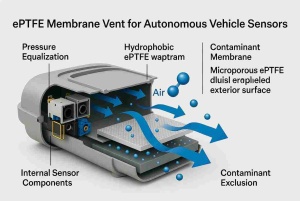
Expanded polytetrafluoroethylene (ePTFE) is produced by controlled biaxial stretching of PTFE, creating a microporous network of nodes connected by fine fibrils. Pore sizes are engineered in the sub-micron to low-micron range, allowing individual gas molecules (oxygen, nitrogen, water vapor) to diffuse through while liquid water droplets are prevented from entering by surface tension and the hydrophobic nature of the fluoropolymer. Many ePTFE constructions also incorporate oleophobic treatments to resist oils and automotive fluids. The material remains chemically inert across a broad temperature range, exhibits low outgassing, and retains mechanical integrity under prolonged UV and ozone exposure. When integrated into a complete vent assembly and tested according to IEC 60529, ePTFE membranes enable enclosures to achieve IP67, IP68, and IP69K ratings while preserving the breathability needed for pressure management and condensation control.
Performance Requirements and Validation Testing for AV Vents
Vents intended for autonomous vehicle sensors must satisfy multiple layered specifications. Ingress protection ratings (IP67/IP68/IP69K) confirm resistance to water and dust under defined conditions. Additional automotive-relevant validations typically include thermal cycling, vibration, thermal shock, and exposure to automotive chemicals. The membrane and supporting structures must maintain consistent airflow characteristics (often measured by Gurley or similar air-permeability methods) and water-entry pressure throughout the vehicle’s service life. Documentation from accredited laboratories—such as SGS, CE, UL, RoHS, REACH, and PFOA-Free declarations—provides traceability and supports regulatory compliance. These tests are performed on the finished vent assembly, not only on the raw membrane, to reflect real-world integration conditions.
Custom Design Options for Seamless Integration with Sensor Modules
No single vent geometry fits every sensor housing. Custom solutions address specific requirements for mounting method, envelope dimensions, required pressure-relief rate, and environmental exposure. Common integration approaches include adhesive-backed vents for flat or gently curved surfaces, screw-in or snap-fit designs for mechanical retention, and overmolded constructions for permanent integration during housing molding. Membrane thickness, pore-size distribution, and lamination layers can be adjusted to balance airflow, water resistance, and durability. Protective outer covers or pre-filter layers may be added for high-dust environments. Because autonomous sensor modules often have tight packaging constraints and strict optical or electromagnetic requirements, early collaboration between vent designers and sensor engineers helps avoid interference with fields of view or signal paths.
Enhancing Reliability in Autonomous Driving Through Advanced Venting
When pressure equalization and contaminant exclusion are reliably achieved, sensor housings maintain stable internal conditions across seasonal and operational extremes. This stability helps preserve optical clarity for cameras and LiDAR, protects sensitive electronics from corrosion, and reduces the frequency of maintenance interventions. Over the vehicle lifetime, consistent vent performance contributes to lower warranty exposure and supports the high uptime expectations of autonomous fleets. The combination of material science and application-specific engineering therefore forms a practical layer of protection that complements other sealing and thermal-management measures.
Accessing Custom ePTFE Vent Solutions from Experienced Specialists
Engineers and product development teams working on autonomous vehicle sensor platforms benefit from partners who combine deep polymer-materials knowledge with proven capability in automotive-grade applications. Spider(Xiamen) Technology Co., Ltd., founded in 2016, has focused for more than ten years on ePTFE membranes and high-performance protective breathable products. Its R&D team, composed of professionals holding master’s and doctoral degrees in polymer materials, allocates between 5 % and 20 % of annual revenue to new product development and process innovation. The company operates under ISO 9001 and IATF 16949 quality management systems and supplies validated components to customers in the automotive, new energy, electronics, and related sectors across Europe, North America, Asia, and other regions. Its guiding principle—integrity builds quality and innovation leads the future—underpins a commitment to technically sound solutions that also respect environmental and regulatory responsibilities.
Development teams seeking application-specific venting recommendations, material data, or prototype support for autonomous vehicle sensor projects are welcome to contact the engineering team for technical consultation.
By SST R&D Engineering Team, Spider(Xiamen) Technology Co., Ltd. weitaiyan@spider-amoy.com