
Deep Waterproof Technology for Smartwatches: Standards, Challenges, and ePTFE Protection Solutions
2025-12-18
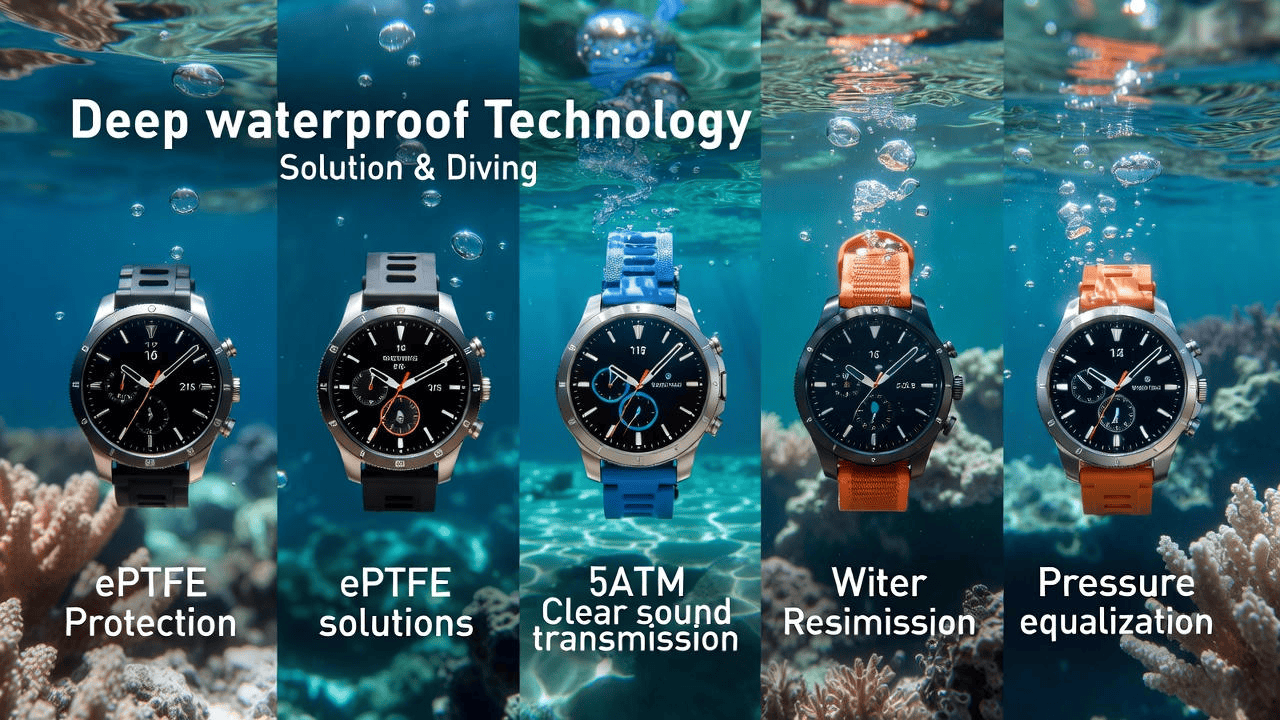
Modern smartwatches increasingly support swimming, diving, and other underwater activities, with growing user demand for reliable depth waterproofing. Ratings of 5ATM or higher have become common in many sports-oriented models, requiring devices to resist water ingress and particulate contamination while maintaining sound transmission and internal pressure equalization.
Regulatory Background
The International Electrotechnical Commission (IEC) standard IEC 60529 defines degrees of protection provided by enclosures (IP codes). The second characteristic numeral addresses liquid ingress protection: IPX7 specifies that devices can withstand immersion in water up to 1 meter deep for 30 minutes without harmful effects; IPX8 permits continuous immersion beyond these conditions, with depth and duration specified by the manufacturer, commonly applied to 50-meter (5ATM) and higher scenarios.
ISO 22810:2010 outlines requirements and test methods for water-resistant watches, including static pressure testing equivalent to specified depths. This standard applies to watches with rated water resistance, typically up to 100 meters, primarily for conditions like swimming.
Under EU REACH regulations, restrictions on per- and polyfluoroalkyl substances (PFAS, including PFOA) continue to tighten. The European Chemicals Agency (ECHA) released an updated broad PFAS restriction proposal in August 2025, advancing deliberations in subsequent committee meetings to reduce environmental emissions.
Industry Challenges
Water ingress remains one of the primary failure modes in smartwatches. Market analysis from 2024 indicates that water damage accounts for approximately 25–30% of after-sales repairs, causing significant economic losses for consumers. Earlier 2020 data also reported water-related issues at around 15%.
Microphones and speakers are particularly susceptible to water pressure, sweat, and fine particles (1–10 μm), leading to acoustic distortion or internal corrosion. Traditional sealing methods often struggle to balance high waterproofing with pressure equalization, potentially resulting in enclosure deformation or condensation buildup after prolonged immersion.
The microporous structure of ePTFE materials (typical pore size 0.1–0.5 μm) allows air molecules to pass while blocking liquid water (based on surface tension principles), effectively mitigating these issues.
Common Waterproof Rating Comparison
| Waterproof Rating | Equivalent Depth | Test Conditions (ISO 22810/IEC 60529) | Typical Application Scenarios |
|---|---|---|---|
| 3ATM | 30 meters | Static pressure, brief immersion | Everyday splashes, hand washing |
| 5ATM | 50 meters | Static pressure, suitable for swimming | Swimming, snorkeling |
| 10ATM | 100 meters | Higher static pressure | Shallow diving (non-professional) |
SST Product Advantages and Solutions
Spider (Xiamen) Technology Co., Ltd. (SST) offers the SST-Porous® AV-00 series, which uses substrate-free ePTFE membranes. These achieve acoustic loss of ≤3 dB at 1 kHz, support IPX8-rated immersion at 50 meters for 1 minute, and provide air flow rates up to 150 ml/cm²/min (@70 mbar) in certain configurations. The microporous structure resists liquid and particulate ingress while enabling pressure balancing and clear sound transmission, suitable for smartwatch microphones, speakers, and vents.
Key Parameters of AV-00 Series (Examples)
| Parameter | Typical Value | Notes |
|---|---|---|
| Acoustic Loss (1 kHz) | ≤3 dB | Maintains clear calls and music |
| Waterproof Rating | IPX8 (50 meters, 1 minute) | Supports underwater activities |
| Air Permeability | 150 ml/cm²/min (@70 mbar) | Rapid pressure equalization |
| Thickness | 10–250 μm | Easy integration |
| Surface Treatment | Oleophobic | Resists sweat contamination |
Materials comply with PFOA-free requirements.
Why Choose SST
Spider (Xiamen) Technology Co., Ltd. was established in 2016 and has focused on ePTFE membranes and protective venting products for over a decade. Products achieve protection levels up to IP67/IP68/IP69K and hold certifications including ISO 9001 and IATF 16949. Third-party reports, such as SGS, CE, UL, PFOA-Free, RoHS, and REACH compliance, are available.
Products export to regions including Europe, India, Japan, Russia, the United States, Turkey, Germany, and Korea, serving over 1,000 enterprises worldwide with customized solutions and support services.
SST Industry Applications
The SST-Porous® series applies to smartwatch acoustic components (microphones and speakers) and venting ports. Integration supports die-cutting and welding during design phases. Validation aligns with IEC 60529 immersion tests and ISO 22810 pressure requirements, ensuring compliance with relevant standards.
SST Mission, Values, and Innovation Commitment
SST upholds the core philosophy of “Integrity Builds Quality, Innovation Leads the Future,” balancing economic performance with social responsibility, including environmental protection obligations to promote harmony between human activities and nature. The company maintains a research team of master’s- and doctoral-level polymer materials specialists, investing 5–20% of annual revenue in new product development.
Frequently Asked Questions
Can a 5ATM smartwatch be used for diving? It is generally suitable for swimming and snorkeling but not recommended for professional deep diving (due to dynamic water pressure impacts).
How does an ePTFE membrane achieve both waterproofing and acoustic transparency? The microporous structure blocks liquid water droplets (surface tension exceeds pore size) while allowing sound waves and air to pass, resulting in minimal acoustic loss.
What impact do PFAS restrictions have on waterproof materials? They drive the industry toward PFAS-free alternatives, and SST already provides compliant products.
For discussions on customized deep waterproof solutions for smartwatches, contact us at info@spider-amoy.com.