
Automotive headlights must deliver consistent illumination under rapidly changing environmental conditions. Temperature swings, humidity, rain, and vehicle cleaning processes create pressure differentials inside the lamp housing that can draw moist air inward, leading to condensation on the lens. This fogging reduces light output, scatters the beam, and accelerates degradation of reflectors and electronic components. Proper venting that equalizes pressure while blocking liquid water is therefore a fundamental design requirement for reliable headlamp performance and safety.
The Engineering Challenge of Condensation in Automotive Headlights
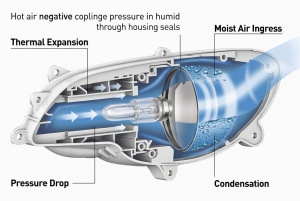
Headlight housings experience repeated thermal cycling. During operation, heat from LEDs or legacy bulbs expands the internal air volume, raising pressure. When the vehicle stops or encounters cold rain, rapid cooling creates a partial vacuum. Any pathway through gaskets, seams, or imperfect seals then becomes an entry point for external air carrying water vapor. Once internal surfaces drop below the dew point, vapor condenses into visible droplets or films on the lens.
The consequences extend beyond aesthetics. Reduced luminous flux compromises nighttime visibility. Persistent moisture accelerates corrosion of metal reflectors and can affect LED driver electronics. For vehicle manufacturers and Tier-1 suppliers, this translates into higher warranty claims, customer dissatisfaction, and potential regulatory scrutiny over lighting performance.
Pressure Dynamics and Moisture Ingress: A Technical Overview
Air behaves according to the ideal gas law: pressure changes proportionally with absolute temperature when volume is fixed. A sealed or poorly vented housing cannot accommodate these changes without stress on structural joints or seals. Over time, repeated pressure events fatigue gaskets and create micro-pathways. Once established, these pathways allow humid air to enter during every cooling cycle.
Effective mitigation requires a controlled exchange of air that keeps internal pressure close to ambient while preventing liquid water from crossing the boundary. This is the core function of high-performance protective vents.
ePTFE Technology: Enabling Breathable yet Protective Barriers
Expanded polytetrafluoroethylene (ePTFE) possesses a distinctive microstructure of PTFE nodes interconnected by fine fibrils. The resulting pores are small enough to inhibit liquid water penetration under significant pressure differentials yet large enough to permit rapid diffusion of air and water vapor. PTFE’s inherently low surface energy causes water to bead rather than wet or wick through the membrane.
Key functional attributes include:
- High air permeability that supports fast pressure equalization during thermal transients.
- Hydrophobic behavior that maintains liquid water resistance even under road spray, car-wash jets, or temporary immersion.
- Particle filtration that reduces dust and contaminant ingress.
- Chemical inertness and stability across wide temperature ranges typical of exterior automotive exposure.
- Long-term durability under vibration, UV, and thermal shock.
These characteristics directly address the dual requirements of pressure balance and condensation prevention in headlight applications. With more than ten years of specialization in ePTFE membranes and protective venting components, Spider(Xiamen) Technology Co., Ltd. has developed formulations and component architectures refined through continuous polymer materials research. Our R&D team, composed of professionals holding master’s and doctoral degrees, reinvests between 5% and 20% of annual revenue into new product development and performance enhancement. This work is guided by the principle that integrity builds quality while innovation leads the future.
Vent Cap Designs for Headlight Pressure Balance and Condensation Control
Automotive lighting vent caps integrate ePTFE membranes into compact, protected housings. The cap is typically mounted on the rear or lower portion of the headlight assembly, positioned to minimize direct water impingement while maximizing effective airflow.
Common mounting options include:
- Adhesive-backed designs for streamlined high-volume assembly on plastic housings.
- Snap-fit or screw-in configurations that provide mechanical retention and serviceability.
- Weldable variants for specific housing materials and sealing requirements.
The membrane support structure and protective cover are engineered to maintain consistent airflow even when the vehicle encounters vibration or debris. By allowing continuous yet controlled gas exchange, the vent reduces the magnitude and duration of pressure differentials that would otherwise drive moist air through housing interfaces. Over extended periods, this also supports gradual outward diffusion of any accumulated moisture vapor, helping maintain lower average internal humidity.
Essential Performance Criteria and Industry Standards
When evaluating venting solutions for headlight programs, engineering teams focus on measurable parameters validated against recognized standards:
- Ingress Protection ratings (IEC 60529): IP67 for temporary immersion, IP68 for prolonged immersion, and IP69K for high-pressure, high-temperature cleaning cycles.
- Airflow capacity sufficient to equalize pressure within the thermal time constants of the specific lamp volume and expected temperature ramp rates.
- Water entry pressure (hydrostatic resistance) that exceeds worst-case dynamic pressures from road spray or cleaning equipment.
- Operating temperature range, typically spanning at least −40 °C to +125 °C, with retention of properties after thermal cycling.
- Resistance to automotive chemicals, road salts, and UV exposure.
Suppliers holding ISO 9001 and IATF 16949 certifications, together with third-party documentation such as SGS, CE, UL, RoHS, REACH, and PFOA-Free reports, provide the process control and traceability expected in automotive supply chains. Products from Spider(Xiamen) Technology Co., Ltd. are engineered and validated to these levels and have been supplied to more than 1,000 enterprises across Europe, the United States, Germany, South Korea, Japan, India, Russia, Turkey, and additional markets.
Practical Guidance for Selecting and Integrating Venting Solutions
Successful implementation begins with a clear understanding of the application envelope:
- Estimate housing volume and anticipated thermal profiles to determine required pressure equalization speed.
- Define the target IP rating and water-entry resistance based on vehicle segment and expected exposure (on-road, off-road, heavy wash cycles).
- Select mounting method compatible with housing material, assembly process, and service strategy.
- Verify long-term durability through appropriate accelerated testing (thermal shock, humidity cycling, vibration).
- Collaborate early with the venting supplier’s application engineers to match membrane characteristics—pore structure, lamination, and support geometry—to the specific performance window.
Engineers seeking detailed specifications, airflow data under defined pressure differentials, or support for custom vent cap configurations can contact our technical team at weitaiyan@spider-amoy.com.
Long-Term Value: Reliability, Safety, and Reduced Lifecycle Costs
Properly specified ePTFE vent caps deliver measurable outcomes: sustained optical clarity, protection of LED arrays and drivers from moisture-related stress, and reduced incidence of field failures. These benefits support compliance with stringent automotive reliability targets and contribute to lower total cost of ownership through fewer warranty events and extended service life.
By addressing the root physical mechanisms—pressure imbalance and liquid water ingress—rather than merely treating symptoms, ePTFE-based venting represents a materials-science approach aligned with the demands of modern vehicle lighting systems.
By SST R&D Engineering Team, Spider(Xiamen) Technology Co., Ltd.