
Many industrial, automotive, and electronic devices must operate reliably in environments where water, dust, chemicals, and temperature fluctuations are constant threats. Enclosures often need high ingress protection ratings while still allowing internal pressure to equalize and moisture vapor to escape. Without this balance, designers face compromised seals, condensation, corrosion, fogging, or housing deformation.
The choice of material for protective vents or membranes directly affects product reliability, service life, and safety. This article examines why ePTFE (expanded polytetrafluoroethylene) membranes frequently outperform conventional options in these demanding conditions.
The Challenge of Waterproof Breathable Protection in Modern Applications
Engineers in electronics, new energy, automotive, outdoor equipment, and medical device sectors routinely encounter a core conflict: achieve robust sealing against liquids and particulates while permitting controlled gas exchange.
Temperature changes, altitude shifts, or internal heat generation create pressure differentials that stress housings and seals. Trapped moisture vapor leads to condensation, which corrodes circuits, degrades optics, or triggers failures in sensors and battery systems. Effective solutions must therefore combine high water resistance with meaningful air permeability and vapor transmission, all while maintaining long-term stability under real-world stresses.
Limitations of Traditional Materials
Conventional approaches often force undesirable trade-offs. Dense elastomers such as rubber or silicone provide excellent initial waterproofing but block virtually all air and vapor movement. The result is pressure buildup, seal fatigue, or internal moisture accumulation over time.
Basic woven or non-woven fabrics and simple filters may allow some airflow yet typically deliver lower and less consistent water resistance, especially after exposure to oils, chemicals, or repeated flexing. Sintered metal vents can handle certain pressure-relief tasks but add weight, risk corrosion in aggressive environments, and offer limited control over filtration or breathability consistency.
Across these options, designers frequently accept either compromised protection or reduced ventilation performance, leading to higher warranty claims or more conservative product designs.
ePTFE Technology: The Microporous Advantage
ePTFE is produced by rapidly expanding PTFE under controlled conditions, creating a unique node-and-fibril microstructure. This forms a network of microscopic pores that are large enough for air molecules and water vapor to diffuse through yet small enough, combined with the material’s inherent hydrophobicity, to resist penetration by liquid water droplets under significant pressure.
The result is a membrane that can support high ingress protection ratings while enabling effective pressure equalization and moisture vapor transmission. The polymer itself is chemically inert, stable across wide temperature ranges, and resistant to UV, aging, and most industrial fluids. These characteristics arise directly from the material science of expanded PTFE rather than from surface coatings or secondary treatments that can degrade over time.
Side-by-Side Comparison of Key Properties
The practical differences become clear when properties are compared directly:
| Property | Typical Traditional Materials | ePTFE Membranes |
|---|---|---|
| Waterproof performance | High when fully sealed, but often rigid | High; supports IP67, IP68, and IP69K designs when properly integrated |
| Breathability / vapor transmission | Very low or negligible | High; permits gas exchange and moisture escape |
| Pressure equalization | Limited; can stress housings | Excellent; reduces mechanical stress on enclosures |
| Chemical and corrosion resistance | Varies; many degrade with oils or solvents | Outstanding; inherently inert to most chemicals |
| Temperature stability | Often narrower operating window | Broad; maintains performance in extreme cold and heat |
| Long-term durability | Can embrittle, soften, or clog | Generally superior resistance to environmental aging and mechanical cycling |
These distinctions matter most in applications where devices experience repeated thermal cycling, chemical exposure, or the need for consistent performance over years rather than months.
Where ePTFE Delivers Clear Benefits in Practice
In electric vehicle battery systems, ePTFE-based vents help manage internal pressure generated during normal operation or thermal events while blocking coolant, water, and dust. This supports both daily reliability and safety-related pressure relief functions.
In automotive electronics and sensors, the membranes protect control units and radar modules from harsh under-hood or exterior environments without trapping moisture that would otherwise cause corrosion or signal drift.
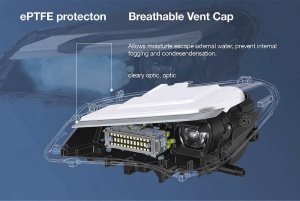
For LED headlamps and outdoor enclosures, effective vapor transmission reduces internal fogging, preserving optical clarity and extending component life. Industrial control cabinets and IoT devices similarly benefit from reduced condensation risk while maintaining high dust and water protection.
Across these sectors, the combination of verified ingress protection, breathability, and material durability helps engineers meet stringent reliability targets without excessive design compromises.
Guidance for Selecting the Right Solution
When evaluating options, define the specific requirements first: target IP rating, maximum allowable pressure differential, required airflow or vapor transmission rate, chemical and temperature exposures, and preferred mounting method (adhesive, weldable, threaded, or snap-fit).
Next, assess long-term factors such as expected service life, maintenance access, and total cost of ownership, including potential failures caused by inadequate breathability or material degradation.
Third-party test data, including water entry pressure, air permeability, and environmental aging results, provide objective evidence for comparison. Certifications and quality system documentation further help confirm consistency and traceability.
Advancing Protection Technology Through Dedicated Research
Spider(Xiamen) Technology Co., Ltd. has specialized in ePTFE membranes and high-performance protective breathable products since 2016. The company’s R&D engineering team, composed of professionals holding advanced degrees in polymer materials, invests between 5% and 20% of annual revenue in new product development and performance improvement.
All solutions are developed and produced under ISO 9001 and IATF 16949 quality management systems and are supported by comprehensive third-party documentation, including SGS, CE, and UL reports together with RoHS, REACH, and PFOA-Free compliance verification. This framework reflects the guiding principle that integrity builds quality and innovation leads the future, ensuring solutions remain reliable and progressively more capable for customer applications worldwide.
For technical consultation on material selection, custom membrane configurations, or integration support for your specific waterproof breathable protection requirements, contact the team at weitaiyan@spider-amoy.com.
By SST R&D Engineering Team, Spider(Xiamen) Technology Co., Ltd.