
The transition toward more environmentally responsible materials is influencing component selection across electronics, automotive, new energy, medical devices, and outdoor equipment. Waterproof breathable membranes, used for pressure equalization, condensation prevention, and ingress protection, are part of this shift. Engineers and technical decision-makers now evaluate options that maintain high performance while addressing concerns around per- and polyfluoroalkyl substances (PFAS).
This article provides a clear, practical overview of PFAS considerations in waterproof breathable membranes, the emergence of Non-Flon (fluorine-free) alternatives, key engineering trade-offs, and how specialized experience in polymer membrane technology supports informed choices.
Understanding PFAS Concerns and the Role of Non-Flon Alternatives
PFAS are a broad class of synthetic chemicals valued for water, oil, and stain resistance but known for environmental persistence and potential health implications. Regulatory pressure is increasing in major markets, prompting manufacturers to reduce or eliminate certain PFAS in finished products and supply chains.
Traditional expanded polytetrafluoroethylene (ePTFE) membranes deliver excellent waterproofing and breathability through a microporous node-and-fibril structure. However, ePTFE is a fluoropolymer and therefore falls under the PFAS category. Many modern ePTFE materials are produced without PFOA (a specific processing aid historically associated with PTFE manufacturing), and suppliers can provide third-party verification of PFOA-free status.
At the same time, completely fluorine-free membranes—often called Non-Flon or PFAS-free alternatives—are gaining attention. These typically use other polymer systems with microporous or monolithic structures. They aim to deliver comparable water resistance and vapor transmission while removing fluorine chemistry entirely. Performance can vary significantly depending on the specific formulation, thickness, and supporting layers.
Key Performance Requirements and Engineering Trade-offs
Effective industrial waterproof breathable membranes must satisfy several often-conflicting demands:
- High water entry pressure (WEP) or hydrostatic head to achieve IP67, IP68, or IP69K ingress protection.
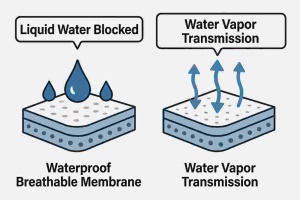
- Sufficient moisture vapor transmission rate (MVTR) or air permeability to equalize pressure and reduce condensation risk inside enclosures.
- Long-term durability under temperature cycling, vibration, chemical exposure, and UV.
- Consistent quality across production batches for safety-critical or high-volume applications.
ePTFE generally excels in harsh environments because of its inherent chemical inertness, wide temperature range, and stable microporous structure. Non-Flon alternatives can achieve strong results in many conditions but may require different design approaches—such as adjusted pore architecture, additional support layers, or application-specific lamination—to approach similar protection levels without fluorine. In practice, the optimal choice depends on the exact operating environment, required service life, and regulatory documentation needs rather than a universal “best” material.
How Specialized R&D Supports Reliable, Sustainable Solutions
Developing and validating high-performance membranes that meet both protection standards and evolving environmental expectations requires substantial materials science expertise and systematic testing. Spider(Xiamen) Technology Co., Ltd, founded in 2016, has focused for more than ten years on ePTFE membranes and high-performance protective breathable products. The company maintains a professional R&D team composed of master’s and PhD-level polymer materials specialists.
Each year, 5%–20% of revenue is directed toward new product development and process innovation. This sustained investment enables continuous refinement of membrane formulations, structures, and manufacturing processes. The result is a portfolio that includes both high-specification ePTFE solutions and Non-Flon fluorine-free vent options designed for demanding applications.
All products are developed under ISO 9001 and IATF 16949 quality management systems. Customers can obtain supporting documentation including SGS, CE, UL, RoHS, REACH, and PFOA-Free test reports to support their own compliance verification. These capabilities allow the company to serve more than 1,000 enterprises worldwide, with products exported to Europe, the United States, Germany, Japan, South Korea, India, Russia, Turkey, and other regions.
Guided by the principle of integrity building quality and innovation leading the future, the team focuses on solutions that balance technical performance with broader environmental considerations.
Practical Guidance for Selecting Membranes in Regulated Applications
When evaluating PFAS-conscious waterproof breathable options, technical teams typically consider the following:
- Application-specific conditions — temperature range, chemical or oil exposure, mechanical stress, and required IP rating. Safety-critical uses (for example, EV battery pressure management or sensor protection) often prioritize proven long-term reliability data.
- Documentation and verification — supplier declarations alone are rarely sufficient. Request independent laboratory reports that address the specific substances restricted in target markets.
- Performance balance — higher protection levels generally involve trade-offs in breathability or physical size. Early modeling or prototype testing helps quantify these effects.
- Customization support — membrane properties (pore size distribution, thickness, hydrophobicity) and vent formats (adhesive, screw-in, snap-fit, weldable) can often be tailored. Suppliers with strong engineering collaboration reduce development risk and time.
- Total lifecycle perspective — beyond initial compliance, consider consistency of supply, quality stability, and the supplier’s ability to support future regulatory changes.
Experienced membrane specialists can help map these factors to concrete recommendations rather than generic claims.
Moving Forward with Informed Material Choices
The shift toward Non-Flon and PFAS-reduced materials represents meaningful progress in sustainable industrial design. However, maintaining the high levels of protection required in electronics, automotive, new energy, and medical applications demands rigorous materials engineering and validation. Companies with deep, focused experience in polymer membrane technology are well positioned to help customers navigate these requirements effectively.
Spider(Xiamen) Technology Co., Ltd continues to advance both its ePTFE capabilities and Non-Flon fluorine-free solutions to support clients who need reliable waterproof breathable protection aligned with environmental objectives.
For technical consultation, detailed specifications, test data, or assistance in identifying suitable membrane options for your application, contact the engineering team at weitaiyan@spider-amoy.com.
By SST R&D Engineering Team, Spider(Xiamen) Technology Co., Ltd.