
Modern vehicles rely heavily on advanced driver assistance systems (ADAS), radar modules, cameras, and electronic control units (ECUs) for safety and performance. These components operate in extremely harsh environments—exposed to road spray, washdowns, temperature swings from -40°C to over 100°C, vibration, road salt, dust, and rapid pressure changes from altitude, speed, or thermal cycling. Without proper protection, moisture ingress can cause condensation (fogging lenses or corroding electronics), while pressure differentials can deform housings or compromise seals, leading to failures, reduced sensor accuracy, or costly warranty issues.
ePTFE (expanded polytetrafluoroethylene) breathable vents have become a standard solution for protecting these sensitive systems. They enable reliable pressure equalization and moisture management while maintaining high ingress protection ratings.
Challenges in Automotive Sensor and ECU Protection
Automotive radar (such as mmWave units for adaptive cruise control or collision avoidance) and cameras (surround-view, rearview, or driver-monitoring systems) are typically mounted in exposed locations like bumpers, mirrors, or grilles. Key challenges include:
- Pressure imbalances: Rapid temperature changes or vehicle movement create internal vacuum or overpressure, stressing seals and housings.
- Condensation and moisture: Temperature differentials cause internal fogging on camera optics or corrosion on ECU/sensor boards.
- Contaminant ingress: Water, dust, salt, oil mist, and insects can enter through imperfect seals.
- Vibration and durability: Constant road vibration and thermal cycling demand robust, long-life solutions.
- Space and integration constraints: Modern compact designs require low-profile or adhesive-mounted protection.
These issues directly impact sensor reliability, signal integrity, and overall vehicle safety.
How ePTFE Breathable Vents Work
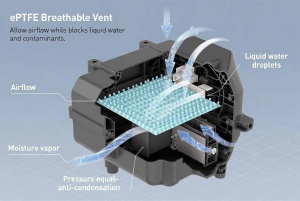
ePTFE membranes feature a unique microporous structure of nodes connected by fibrils. This creates tortuous paths that:
- Allow rapid air and moisture vapor transmission for pressure equalization and anti-condensation (moisture diffuses out before it condenses).
- Provide excellent hydrophobic properties and high water entry pressure, blocking liquid water, dust, and contaminants.
- Resist chemicals, oils, UV, and wide temperature ranges typical in automotive use.
The result is effective IP67/IP68 (and sometimes higher) protection without active components. Vents can be adhesive (ideal for space-limited radar or camera modules), snap-in, screw-in, or weldable, depending on enclosure design. They respond quickly to pressure changes while maintaining consistent airflow.
Applications in Automotive Radar Systems
Radar sensors require sealed yet ventilated housings to protect internal electronics from environmental damage while preserving performance. ePTFE vents are commonly integrated into radar modules to:
- Equalize pressure and prevent housing deformation or seal fatigue during temperature swings or altitude changes.
- Block water and road contaminants that could affect antenna performance or electronics.
- Manage moisture to avoid corrosion or signal degradation.
In practice, these vents support reliable operation of ADAS radar in rain, snow, car washes, and extreme climates. Low-profile adhesive versions fit compact radar enclosures without interfering with signal paths.
Applications in Camera and Vision Systems
Camera modules are particularly sensitive to internal condensation, which can obscure lenses or damage image sensors and processing electronics. ePTFE breathable vents address this by:
- Allowing moisture vapor to escape, preventing fogging on internal optics or glass.
- Protecting ECUs and sensor boards from corrosion caused by trapped humidity.
- Providing a robust barrier against external water, dust, and salt while permitting necessary gas exchange.
Adhesive ePTFE vents are especially valuable here due to limited space in modern camera housings. They help maintain clear vision for ADAS functions like lane-keeping, automatic emergency braking, and parking assistance across diverse weather conditions.
Performance Benefits in Demanding Conditions
Industry applications demonstrate several consistent advantages of ePTFE solutions:
- Extended component life — Reduced condensation and contaminant-related failures lower warranty claims and improve long-term reliability.
- Maintained sensor performance — Stable internal environments support consistent radar accuracy and camera clarity.
- Design flexibility — Multiple mounting options and customizable airflow/waterproofing balance accommodate various enclosure sizes and requirements.
- Compliance and durability — Materials withstand automotive-grade testing (thermal cycling, vibration, chemical exposure) and support high IP ratings.
- Passive operation — No power or moving parts required, simplifying integration and improving robustness.
These benefits are especially critical as vehicle sensor density increases with higher levels of autonomy.
Implementing Effective Protective Venting Solutions
Engineers and designers should evaluate vents based on:
- Required airflow rate and pressure equalization speed for the specific enclosure volume and expected environmental changes.
- Target IP rating and long-term durability under vibration, temperature extremes, and chemical exposure.
- Mounting method suited to available space and assembly process (adhesive patches excel in compact radar and camera designs).
- Validation through relevant testing: IP ingress, thermal shock, vibration, and real-world field trials.
- Material compatibility and full traceability for automotive quality systems.
Early supplier engagement helps optimize vent placement, size, and specifications for each application.
With more than 10 years of specialization in high-performance ePTFE membranes and protective breathable products, Spider(Xiamen) Technology Co., Ltd. supports automotive applications including ECUs, sensors, radar, and camera modules. The company operates under ISO 9001 and IATF 16949 quality systems and provides solutions achieving IP67/IP68/IP69K ratings, backed by comprehensive testing and certifications such as SGS, CE, UL, PFOA-Free, RoHS, and REACH. A dedicated polymer materials R&D team invests significantly in ongoing innovation to meet evolving automotive protection needs. Products have supported customized solutions for global customers in demanding environments.
For technical specifications, sample evaluation, or consultation on integrating ePTFE breathable vents into radar, camera, or other automotive sensor designs, contact the team at weitaiyan@spider-amoy.com.
By SST R&D Engineering Team, Spider(Xiamen) Technology Co., Ltd.