
Sealed electronic enclosures face a constant engineering challenge: protecting sensitive components from water, dust, and contaminants while managing internal pressure changes caused by temperature fluctuations, altitude shifts, or rapid environmental swings. Without proper venting, pressure differentials can stress seals, force water ingress, or create condensation that leads to corrosion and failure.
SST Adhesive Vent addresses this precisely. It is a thin, self-adhesive ePTFE membrane solution designed for straightforward integration into electronic housings. Developed by Spider(Xiamen) Technology Co., Ltd., it delivers reliable IP67 and IP68 waterproof breathable performance without complex mechanical fittings.
What Is an SST Adhesive Vent?
An SST Adhesive Vent is a ready-to-apply protective membrane consisting of a microporous expanded polytetrafluoroethylene (ePTFE) layer bonded to a high-performance acrylic adhesive backing. It is applied directly over a small opening or vent hole in the enclosure wall.
Unlike traditional open holes or bulky valves, the adhesive format requires no tools, screws, or welding. Once pressed into place, it forms a continuous barrier that equalizes air pressure while blocking liquid water and particulate matter. The result is a clean, low-profile seal that maintains the enclosure’s integrity under demanding conditions.
How ePTFE Technology Enables Waterproof Breathability
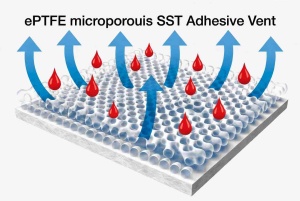
The core performance of SST Adhesive Vent comes from the unique structure of ePTFE. Expanded PTFE creates a three-dimensional network of microscopic pores—typically in the sub-micron range. These pores are large enough to allow air molecules and water vapor to pass freely, yet small enough that liquid water is held back by surface tension.
This selective permeability achieves two critical functions simultaneously:
- Continuous pressure equalization that prevents seal stress or housing deformation.
- Hydrophobic and oleophobic surface properties that repel water, oils, and many industrial fluids.
The membrane itself is chemically inert, UV-resistant, and temperature-stable across wide operating ranges typical of outdoor electronics, automotive systems, and industrial controls. Because the material is 100% PTFE-based in its functional layer, it does not degrade under prolonged exposure to humidity or harsh environments.
Achieving IP67 and IP68 Ratings in Sealed Electronics
IP67 and IP68 ratings define specific levels of protection against dust and water immersion. SST Adhesive Vent is engineered and tested to support these ratings when properly applied over a correctly sized vent aperture.
In practice, this means the vent can withstand temporary immersion or high-pressure water jets while still allowing the enclosure to “breathe.” Pressure differentials of several kilopascals are equalized in seconds, reducing the risk of gasket extrusion or housing flexure. Dust particles larger than the pore size are excluded, helping maintain internal cleanliness over the product’s service life.
Independent testing reports (SGS, CE, UL, RoHS, REACH, and PFOA-Free) and compliance with ISO 9001 and IATF 16949 quality systems provide verifiable documentation of these performance characteristics.
Practical Benefits for Electronic Device Protection
For design and reliability engineers, the advantages are concrete:
- Simplified assembly – peel-and-stick installation shortens production time and reduces assembly errors.
- Condensation control – vapor transmission prevents moisture accumulation inside sealed housings during temperature cycling.
- Extended component life – protection against water ingress and pressure-induced stress improves long-term reliability of PCBs, sensors, batteries, and connectors.
- Design flexibility – thin profile and customizable sizes fit tight spaces without compromising aesthetics or mechanical strength.
These benefits are especially valuable in compact consumer electronics, outdoor LED lighting, telecom enclosures, and battery packs where traditional mechanical vents would add cost, weight, or leak paths.
Key Applications Across Industries
SST Adhesive Vent is used wherever sealed electronics must survive real-world conditions:
- Consumer and industrial electronics – outdoor sensors, control modules, and handheld devices.
- Automotive and new-energy systems – ECUs, radar housings, camera modules, and battery enclosures requiring IP67/IP68 sealing.
- Outdoor equipment – lighting fixtures, security cameras, and communication gear exposed to rain, dust, and temperature extremes.
- Medical and specialized instruments – devices needing reliable environmental protection without complex venting hardware.
In each case, the vent acts as a passive, maintenance-free safeguard that supports the overall sealing strategy rather than becoming a weak point.
Why Professional Material Expertise Matters
Selecting and integrating a breathable vent is not a commodity decision. Pore size distribution, adhesive durability, oleophobic treatment, and long-term aging behavior all affect real-world performance. Spider(Xiamen) Technology Co., Ltd. has specialized in ePTFE membranes and high-performance protective vents since 2016. Over more than a decade, the company has supplied customized solutions to more than 1,000 enterprises across Europe, the United States, Germany, Korea, Japan, India, Russia, Turkey, and other markets.
A dedicated polymer-materials R&D team of master’s- and doctoral-level engineers continuously advances membrane technology. Between 5 % and 20 % of annual revenue is reinvested in new product development and process improvement. This focus, guided by the principle “Integrity builds quality, innovation leads the future,” ensures that every SST Adhesive Vent meets rigorous performance and reliability expectations while balancing economic and environmental responsibility.
How to Select and Apply Adhesive Vents Effectively
Successful implementation begins with matching vent area to the enclosure’s free internal volume and expected temperature range. Larger temperature swings or higher altitude changes require greater air-flow capacity. Surface preparation of the housing (clean, dry, and free of mold-release agents) is essential for long-term adhesive bond strength.
Once applied, the vent should be protected from direct mechanical abrasion or continuous high-pressure spray if the application demands IP68 immersion. When these basic design rules are followed, SST Adhesive Vent consistently delivers reliable pressure management and environmental protection.
For engineers evaluating options, technical data sheets, sample kits, and application guidance are available. Specific performance requirements—such as higher oleophobicity, flame-retardant backing, or custom die-cut shapes—can be discussed with the technical team.
In sealed electronics design, the simplest solution is often the most robust. SST Adhesive Vent provides a proven, easy-to-integrate path to IP67/IP68 waterproof breathable protection, grounded in more than ten years of focused ePTFE materials expertise.
For technical consultation, product samples, or customized vent solutions, contact: weitaiyan@spider-amoy.com
By SST R&D Engineering Team, Spider(Xiamen) Technology Co., Ltd.