
New energy vehicle battery packs operate under demanding conditions. Rapid temperature changes during charging and discharging, altitude variations, and continuous thermal cycling create internal pressure differentials. At the same time, the pack must maintain a high level of environmental sealing to prevent water and dust ingress. These competing requirements make reliable pressure equalization essential for long-term pack integrity and safety.
ePTFE membrane vents provide a practical engineering solution by allowing controlled gas exchange while blocking liquid water and particulates.
Pressure Differentials in Sealed Battery Packs
Battery packs are designed as sealed enclosures to meet IP67 or IP68 requirements. When the internal air volume expands or contracts due to temperature or altitude changes, a pressure difference develops relative to the external environment. Without a path for air to equalize, this differential can:
- Stress or displace seals and gaskets
- Force moisture past imperfect interfaces when internal pressure is negative
- Contribute to condensation inside the pack
- Accelerate mechanical fatigue of the housing over repeated cycles
A properly sized ePTFE vent equalizes pressure quickly enough to keep differentials within safe limits while preserving the required ingress protection rating.
How ePTFE Membranes Function in Battery Applications
Expanded polytetrafluoroethylene membranes contain a network of microscopic pores. These pores are small enough that surface tension prevents liquid water from entering, yet large enough for air and water vapor molecules to pass. The material is inherently hydrophobic, so liquid water beads on the surface rather than wetting the membrane.
In a battery pack, the vent assembly is typically mounted on the pack housing or cover. During normal operation and thermal events, air flows through the membrane in both directions as needed, preventing sustained pressure buildup or vacuum conditions.
Key Advantages for New Energy Vehicle Battery Packs
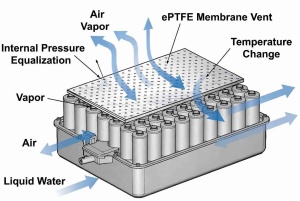
- Simultaneous achievement of high IP ratings (IP67/IP68 and, where required, IP69K) and effective pressure equalization
- Reduction of condensation risk by allowing moisture vapor to escape while blocking liquid water
- Protection of seals and structural components from repeated pressure cycling
- Compatibility with automotive environmental requirements, including temperature extremes, vibration, and chemical exposure
- Compact form factors (adhesive, screw-in, or snap-fit) that integrate with existing pack designs without significant redesign
These characteristics address the dual need for environmental sealing and dynamic pressure management that solid seals alone cannot provide.
Practical Considerations for Battery Pack Integration
Engineers selecting vents for battery packs typically evaluate:
- Air-flow capacity relative to pack free volume and expected temperature/altitude ranges
- Attachment method and long-term reliability under vibration and thermal cycling
- Chemical compatibility with battery electrolytes, coolants, and cleaning agents
- Validation under relevant automotive standards and IP test protocols
Prototype testing under realistic thermal, pressure, and immersion profiles remains the most reliable method to confirm performance.
Engineering Support from Spider(Xiamen) Technology Co., Ltd.
Spider(Xiamen) Technology Co., Ltd. has developed ePTFE membranes and protective venting solutions since 2016. The company maintains a polymer-materials R&D team that includes master’s- and doctoral-level engineers and allocates 5 %–20 % of annual revenue to product and process development. Products are manufactured under ISO 9001 and IATF 16949 quality systems and can be supplied with third-party reports covering SGS, CE, UL, PFOA-Free, RoHS, and REACH requirements.
Vents designed for electronics, automotive, and energy-storage applications, including battery pack protection, have been supplied to customers across multiple regions. The company follows the principle “Integrity Builds Quality, Innovation Leads the Future,” balancing technical performance with environmental responsibility.
For application-specific air-flow calculations, membrane selection, or custom vent designs for battery packs, contact the engineering team at weitaiyan@spider-amoy.com.
By SST R&D Engineering Team, Spider(Xiamen) Technology Co., Ltd.