
Modern vehicles depend on radar modules, cameras, electronic control units and oxygen sensors to deliver ADAS functions, engine management and overall reliability. These components sit in some of the harshest environments on a car: extreme temperature swings, road spray, dust, vibration, chemical exposure and rapid pressure changes. When moisture or pressure differentials get inside the housing, performance drops and failures appear—condensation on camera lenses, drift in radar signals, corrosion on ECU boards or sensor contamination.
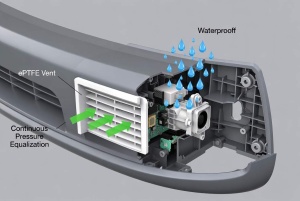
Engineered ePTFE membrane vents address these problems directly by allowing continuous pressure equalization while blocking liquid water, dust and many contaminants. The result is longer service life and more consistent sensor performance under real driving conditions.
Challenges for Each Component
Radar sensors, whether short-range or long-range, need stable internal conditions to maintain accurate detection. Rapid temperature changes create pressure differentials that stress seals and can force moisture past gaskets. Once water or condensation reaches the antenna or electronics, signal integrity suffers.
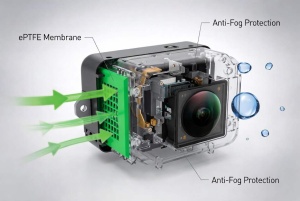
Cameras face a similar but more visible issue. Moisture inside the housing quickly fogs the lens or deposits on the image sensor. Even small amounts of condensation can degrade night vision or surround-view performance. Traditional sealed designs without proper venting often trap humidity that forms when the vehicle cools after operation.
ECUs housings contain dense electronics that are sensitive to both moisture and thermal expansion. Pressure build-up from heat cycles repeatedly loads the seals. Over time this leads to micro-leaks, followed by corrosion or intermittent faults that are difficult to diagnose.
Oxygen sensors operate in the exhaust stream at high temperatures and must withstand corrosive gases while remaining sealed against external contaminants. Pressure fluctuations and condensation during cold starts can introduce moisture that affects sensor accuracy or damages the sensing element.
In all four cases, ordinary vents or completely sealed designs leave gaps in protection. Foam or simple openings clog easily and lose effectiveness. Fully sealed housings suffer from the pressure and condensation problems described above.
How ePTFE Membrane Protection Works in These Applications
An ePTFE membrane consists of a microporous expanded PTFE structure. The pores are large enough for air and water vapor to pass freely, yet small enough—and sufficiently hydrophobic—to block liquid water even under pressure. When the membrane is mounted in a properly designed vent housing, the enclosure can breathe continuously. Internal pressure stays close to ambient, reducing stress on seals. Vapor that would otherwise condense can escape. The same membrane resists clogging better than open foam in dusty or oily environments and maintains performance across a wide temperature range.
For automotive use the vent must also meet chemical resistance requirements and support IP67, IP68 or IP69K ratings when correctly integrated. The membrane itself is inert and does not degrade under typical under-hood or underbody conditions when protected by the housing design.
Application Notes for Radar, Cameras, ECU and Oxygen Sensors
Radar modules benefit from steady pressure equalization that keeps the housing free of moisture without compromising the seal integrity needed for accurate microwave performance. A correctly sized ePTFE vent prevents the cyclic loading that shortens gasket life while allowing any residual humidity to leave.
Camera housings gain clearer optics over time. By equalizing pressure and permitting vapor escape, the membrane reduces the frequency of internal fogging. This is especially useful for exterior cameras exposed to rain, car washes and temperature extremes.
ECU protection focuses on long-term electronics reliability. Continuous breathing limits the pressure differentials that drive moisture past seals and reduces condensation on circuit boards. In practice this translates to fewer moisture-related field returns.
Oxygen sensors and similar exhaust-related components require membranes that tolerate higher temperatures and chemical exposure while still providing pressure relief during thermal cycles. The inert nature of ePTFE supports this environment when the vent is positioned and protected appropriately.
Practical Selection Points
Airflow capacity must match the enclosure volume and expected temperature swing. Chemical compatibility with road salts, oils, cleaning agents and exhaust condensates should be verified. Mounting orientation and physical protection of the membrane against impact or abrasion matter in underbody or wheel-arch locations. Automotive qualification typically requires materials and processes aligned with IATF 16949 systems and supporting test reports.
Spider(Xiamen) Technology Co., Ltd. has specialized in ePTFE membranes and protective vents since 2016. The company operates under ISO 9001 and IATF 16949 quality systems and can provide relevant documentation including SGS, CE, UL, PFOA-Free, RoHS and REACH reports. Solutions have been supplied to automotive and related customers across multiple markets. The polymer R&D team continues to refine membrane formulations and vent designs, with annual investment in the range of 5–20 % of revenue directed toward material and application development.
For application-specific review of radar, camera, ECU or sensor housings, contact weitaiyan@spider-amoy.com.
Automotive sensors and control units fail more often from environmental stress inside the housing than from the electronics themselves. Traditional approaches either restrict breathing or leave the enclosure vulnerable to moisture. A properly specified ePTFE membrane vent removes the pressure differential while maintaining a high level of liquid and particulate exclusion. When reliability under real-world conditions is the priority, that combination is usually the more durable solution.
By SST R&D Engineering Team, Spider(Xiamen) Technology Co., Ltd.