
Sealed enclosures in electronics, automotive systems, EV components, outdoor equipment, and industrial controls must balance environmental protection with the ability to “breathe.” Engineers often face a critical choice: simple ordinary vent holes (drilled openings or basic meshes) versus professional ePTFE (expanded polytetrafluoroethylene) microporous membrane solutions. The difference directly impacts long-term reliability, maintenance costs, and warranty claims.
Challenges with Ordinary Vent Holes in Sealed Enclosures
Ordinary vent holes provide basic airflow but offer minimal protection. They allow unrestricted passage of air, yet they also permit liquid water, dust, insects, and contaminants to enter—especially under rain, pressure washing, vibration, or pressure differentials caused by temperature changes.
Simple holes or basic metal meshes lack hydrophobicity, leading to rapid wetting and clogging. Over time, they degrade from UV exposure, chemicals, oils, or thermal cycling. In harsh environments, this results in seal stress, vacuum-induced moisture ingress, internal condensation, corrosion of electronics, and eventual enclosure or component failure. Studies and field data show these basic solutions frequently fail to maintain consistent performance beyond initial lab conditions, increasing design complexity (e.g., needing extra filters, fans, or thicker housings) and long-term costs.
Technical Superiority of ePTFE Microporous Membranes
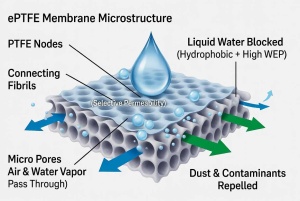
ePTFE membranes feature a unique node-and-fibril microstructure with precisely controlled microscopic pores (typically in the 0.1–0.5 μm range or optimized for the application). This structure is inherently hydrophobic and often oleophobic.
Air molecules and water vapor pass freely through the pores via diffusion and convection, enabling excellent air permeability and moisture vapor transmission rate (MVTR). At the same time, the combination of small pore size and high surface tension of liquid water (plus high water entry pressure) prevents liquid droplets, dust, salts, and many contaminants from penetrating—even under dynamic conditions like temperature swings or high-pressure jets.
This selective permeability delivers true bidirectional breathing without compromising the enclosure’s barrier properties. Professional ePTFE solutions maintain performance across wide temperature ranges (often -40°C to +125°C or higher), resist chemical degradation, and support robust mechanical integration (adhesive, weldable, screw-in, or snap-fit formats).
Pressure Equalization Performance Comparison
Temperature fluctuations, altitude changes, or internal heat generation create significant pressure differentials in sealed enclosures. Ordinary vent holes may allow some equalization if large enough, but they do so at the cost of protection and often lead to inconsistent performance or clogging.
ePTFE vents rapidly equalize pressure with minimal differential (often keeping spikes well below levels that stress seals). Industry testing shows dramatic reductions: pressure differentials can drop from over 100–168 mbar in unvented or poorly vented enclosures to under 20 mbar or even ±4 mbar with effective venting. One analysis indicated proper waterproof breathable designs can reduce peak pressure differences on seals by approximately 30–45%. This passive, continuous equalization prevents housing deformation, gasket fatigue, seal failure, and vacuum-driven ingress of moisture or contaminants.
Moisture Management and Condensation Prevention
Ordinary holes or basic vents do little to manage internal humidity. Warm, moist air trapped or drawn in during pressure cycles cools below the dew point, forming condensation that corrodes circuits, degrades insulation, and causes shorts or failures. Moisture ingress is a leading contributor to electronic failures in automotive and outdoor applications.
ePTFE membranes excel here through high MVTR. They allow water vapor to escape while blocking liquid water, keeping internal relative humidity lower and enabling faster recovery from condensation events. Field and lab comparisons consistently show vented enclosures with ePTFE experience significantly less condensation and related damage compared to sealed or simply vented designs.
Ingress Protection, Durability, and Long-Term Reliability
Ordinary vent holes rarely sustain high IP ratings (such as IP67, IP68, or IP69K) in real-world use, especially after thermal cycling, vibration, or prolonged exposure. They are prone to clogging and loss of effectiveness.
Professional ePTFE solutions are engineered and validated to support and maintain IP67/IP68/IP69K performance over extended periods. Long-term field studies (spanning 5–10+ years) demonstrate stable airflow and water resistance even after harsh environmental exposure. The material resists UV degradation, mechanical fatigue, pore collapse, and chemical attack far better than foam, coated fabrics, or basic polymers. This durability translates to consistent protection throughout the product lifecycle.
Quantifiable Impact on Equipment Failure Rates
The advantages compound into measurable reliability gains. By minimizing pressure stress on seals, preventing vacuum-induced leaks, reducing internal condensation and corrosion, and maintaining high ingress protection, ePTFE-based professional vents significantly lower failure rates in demanding applications.
Real-world examples include reduced warranty claims in automotive electronics and outdoor sensors, extended service life in EV powertrain components and ECUs, and fewer corrosion-related issues in industrial controls. Moisture-related failures can account for a substantial portion of electronic issues in vehicles; effective venting addresses root causes rather than symptoms. Professional solutions also simplify designs by reducing the need for auxiliary components, lowering overall system complexity and cost of ownership.
Why Professional ePTFE Solutions Deliver Superior Results
The performance gap stems from advanced materials engineering. Ordinary vent holes represent a basic, low-cost approach that trades protection for airflow. Professional ePTFE membranes integrate optimized microstructure, surface chemistry, and robust assembly designs to solve multiple problems simultaneously—pressure management, moisture control, and contaminant exclusion—without introducing new failure modes.
With over 10 years of specialized experience in ePTFE membranes and high-performance protective breathable products, teams of polymer material experts (including those with master’s and doctoral backgrounds) at Spider(Xiamen) Technology Co., Ltd. develop solutions tailored to real-world conditions. Significant ongoing investment in R&D (typically 5–20% of resources) drives continuous improvements in membrane performance. Products are manufactured under ISO 9001 and IATF 16949 quality systems and backed by comprehensive testing and certifications, including SGS, CE, UL, RoHS, REACH, and PFOA-Free compliance. These solutions have supported over 1,000 global enterprises in electronics, automotive, new energy, outdoor equipment, and medical device sectors.
Guidance for Selecting Effective Venting Solutions
When evaluating options, consider enclosure volume, expected temperature/pressure cycles, target IP rating, environmental exposures (chemicals, washdowns, vibration), required airflow, and long-term durability needs. Professional ePTFE vents from experienced manufacturers provide the best balance of breathability and protection, enabling reliable performance where ordinary holes fall short.
Engineers and procurement teams seeking to reduce failure rates, extend product life, and optimize designs can benefit from application-specific guidance. For technical consultations, custom configurations, or support in selecting the right ePTFE vent solution for your enclosure, contact the team at weitaiyan@spider-amoy.com.
By understanding these material and performance differences, designers can implement solutions that deliver lasting reliability rather than recurring problems.
By SST R&D Engineering Team, Spider(Xiamen) Technology Co., Ltd.