
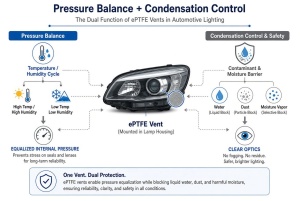
Automotive lighting systems—headlamps, fog lamps, rear combination lamps, and daytime running lights—operate in demanding environments. Rapid temperature swings, high humidity, road spray, and altitude changes create pressure differentials inside sealed lamp housings. These differentials force moisture-laden air past imperfect seals or stress housing joints, leading to internal condensation that reduces light output, accelerates corrosion, and shortens component life. ePTFE protective vents provide a passive, reliable solution for continuous pressure equalization while maintaining high levels of environmental protection.
Why Pressure and Condensation Challenges Occur in Lighting Assemblies
When a lamp is switched on, internal temperature rises quickly. The trapped air expands and creates positive pressure. When the lamp cools or the vehicle climbs in altitude, pressure drops and outside air is drawn inward. If that air carries moisture, condensation forms on lenses and reflectors. Repeated cycles also fatigue gaskets and adhesive bonds. Traditional sealed designs without controlled venting therefore face a trade-off between water-tightness and the need for pressure relief.
How ePTFE Protective Vents Solve the Problem
Expanded polytetrafluoroethylene (ePTFE) membranes feature a microporous structure that allows air and water vapor to pass freely while blocking liquid water, dust, and contaminants. Installed on the lamp housing, the vent equalizes internal and external pressure almost instantly. This reduces mechanical stress on seals and prevents the vacuum effect that pulls moisture inside. At the same time, the hydrophobic and oleophobic properties of ePTFE keep road spray, cleaning chemicals, and fine particulates out of the optical chamber.
The result is lower condensation risk, more stable light performance over the vehicle’s service life, and reduced warranty claims related to fogging or corrosion.
Required Protection Levels for Automotive Lighting
Modern lighting systems commonly require IP67 or IP68 protection. High-performance ePTFE vents are engineered to meet these ratings when correctly integrated. IP67 testing verifies resistance to temporary immersion; IP68 confirms continuous protection under defined pressure conditions. Additional automotive requirements include resistance to high-pressure spray (IP69K in some specifications), thermal cycling from –40 °C to +120 °C or higher near the light source, and exposure to oils, salts, and washer fluids.
Material and Design Factors for Reliable Performance
Effective venting depends on matching airflow capacity to the free air volume of the lamp housing and the expected temperature delta. Membrane area, backing material, and housing design (adhesive, snap-fit, or screw-in) influence both performance and assembly. Placement is critical: vents should be located away from direct water jets and mechanical impact zones yet still experience the full pressure differential of the enclosure.
Spider(Xiamen) Technology Co., Ltd. has specialized in ePTFE membranes and protective venting solutions since 2016. The company’s polymer materials research team, composed of master’s- and doctoral-level engineers, invests 5 %–20 % of annual revenue in membrane formulation, process optimization, and application testing. Products are manufactured under ISO 9001 and IATF 16949 quality systems and are supported by third-party verification including RoHS, REACH, and PFOA-free documentation. Solutions have been supplied to customers across Europe, North America, and Asia for automotive, electronic, and outdoor applications.
Practical Guidance for Lighting Design and Validation Teams
When specifying protective vents for a new lighting design, consider the following:
- Free air volume of the housing and maximum expected temperature swing
- Target IP rating and any chemical or high-pressure spray requirements
- Preferred mounting method and available space on the housing
- Validation protocol (thermal cycling, immersion, pressure pulse, and condensation testing)
Early collaboration on these parameters allows membrane grade and housing style to be optimized together. Custom configurations are frequently developed when standard parts do not fully satisfy packaging or performance constraints.
For technical consultation on pressure equalization and condensation control in automotive lighting, contact weitaiyan@spider-amoy.com.
Properly engineered ePTFE protective vents remove the traditional compromise between sealing and breathability. They deliver continuous pressure balance, reduce condensation risk, and help maintain optical performance and long-term reliability in automotive lighting systems.
By SST R&D Engineering Team, Spider(Xiamen) Technology Co., Ltd.