
New energy vehicles pack more sealed electronics into harsher places than a conventional powertrain ever did. A traction battery housing, an inverter, an e-motor, an on-board charger and a cluster of high-voltage junction boxes all sit close to road splash, wash-down water, vibration and wide temperature swings. Those boxes are sealed for a reason. They still need a controlled path for air.
Protective vents using ePTFE membranes equalize pressure and let water vapor leave, while blocking liquid water and dust. On a battery pack they may sit beside a separate emergency-relief function. On inverters, motors and control units they are usually a single-stage pressure-equalization part. Confusing those two jobs is a common design error.
What Changed When Vehicles Went Electric
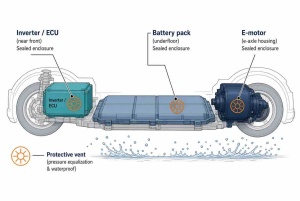
An internal-combustion engine bay is hot, oily and already full of openings. An NEV “three-electric” architecture is different. The battery enclosure is a large, relatively rigid volume with a long gasket line. Power electronics switch hard and heat fast. Fast charging and high-load climbs raise internal air temperature in minutes. Overnight soak or a winter start drops it again.
Altitude adds a second load. A pack sealed at sea level and then driven over a mountain pass can see ambient pressure fall by around 100–140 mbar. The housing and the seal still have to hold IP67, IP68 or IP69K against splash and high-pressure wash.
If that volume cannot breathe, the lid, the gasket and the thinnest wall take the cyclic load. Over a vehicle life that is thousands of thermal and altitude cycles, not a single laboratory dip test.
Pressure Inside Battery Packs and Power Electronics
For a nearly fixed volume of air, pressure tracks temperature. Industry examples of an unvented pack seeing a 50 °C rise in about an hour show differentials on the order of 180 mbar. A correctly sized ePTFE vent can keep the same event closer to 10 mbar. That difference is the load that either fatigues a seal or leaves it alone.
Large battery lids amplify the force. Pressure times area is a real mechanical number on bolts, foam gaskets and weld seams. Inverters and e-motor housings are smaller, but they heat and cool faster, so the rate of pressure change is high. High airflow per unit area matters there.
A protective vent is not a cooling device. It does not replace liquid thermal management. It only keeps the air space from fighting the enclosure.
Condensation Is a High-Voltage Reliability Problem
Warm, humid air trapped in a sealed box reaches dew point when the housing cools. Droplets form on busbars, connectors, PCBs, current sensors and motor windings. In a 12 V cabin module that is a warranty issue. In a high-voltage inverter or BMS box it is insulation resistance, leakage and corrosion.
Moisture can also arrive by thermal pumping. After cooling, internal pressure falls below ambient. Any micro-gap in a gasket or connector becomes an inlet. The enclosure that passed an immersion test when new can slowly lose that rating if vacuum keeps pulling at the joint.
ePTFE vents allow vapor to leave before it condenses and keep the residual pressure low enough that the primary seal is not used as a pump.
Two Different Vent Jobs on a Battery Pack
Everyday protective vents and emergency degassing are not the same function.
- Pressure-equalization vents work continuously at low differential pressure. The ePTFE membrane passes air and vapor both ways and holds a defined water-entry pressure so the pack can keep an IP rating in rain, flood splash and car-wash spray.
- Emergency relief is sized for a rapid gas-generation event. It opens at a set overpressure so the housing does not rupture. Some designs combine both stages in one assembly; others use a breathing vent plus a separate burst path.
A membrane that is excellent at IP69K breathing cannot, by itself, dump the gas volume of a thermal event. A burst disc that never breathes leaves the pack under cyclic pressure every day. Pack engineers specify both requirements against enclosure volume, allowable ΔP, chemistry and the vehicle’s wash and immersion targets. Protective vents are one part of a pack safety concept, not a substitute for cell design, thermal barriers or BMS limits.
Where Protective Vents Belong Across the Vehicle
Battery packs need continuous breathing and, where the safety case requires it, a defined emergency path. Inverters, DC-DC converters and on-board chargers need oleophobic membranes when oils or coolants are nearby, plus enough airflow for fast thermal cycles. E-motor and e-axle housings see heat, splash and sometimes gear-oil mist. Sensors, cameras and lighting still follow the same pressure-and-condensation logic used on conventional vehicles, only with tighter cleanliness and durability expectations.
Mounting follows the housing: screw-in or metal valves on thick walls and packs, adhesive or weldable membranes on polymer covers, snap-fit parts where service or takt time matters. Placement should avoid standing water and, on packs, respect the planned gas-flow direction of any emergency vent.
What to Specify Before Tooling
Match airflow to free volume and the fastest expected temperature or altitude ramp. Confirm water-entry pressure and the IP rating for the installed orientation. Call out oleophobic performance if fluids can reach the membrane. Require automotive temperature, vibration, salt-spray and pressure-cycle data that look like vehicle life, not a single lab point.
Cleanliness matters on high-voltage parts. Particles that would be harmless in a lamp housing are not harmless next to a busbar.
Spider(Xiamen) Technology Co., Ltd., founded in 2016, has worked on ePTFE membranes and protective vent components for more than ten years, including parts used on battery packs, motors and electronic control units. A polymer-materials team at master’s and doctoral level directs 5–20 percent of annual revenue into membrane structure, oleophobic treatment and application assemblies. Production follows ISO 9001 and IATF 16949. Supporting reports can include SGS, CE, UL, PFOA-Free, RoHS and REACH documentation as required. Products are supplied to electronics, automotive, new-energy, outdoor and medical customers in Europe, the United States, Germany, Korea, Japan, India, Russia, Turkey and other markets, serving more than 1,000 companies.
The design question is practical: how much air must move, how much water must stay out, and which function is everyday breathing versus emergency relief. For airflow, WEP and mounting recommendations on NEV enclosures, contact weitaiyan@spider-amoy.com.
By SST R&D Engineering Team, Spider(Xiamen) Technology Co., Ltd.