
Sealed electronic enclosures protect sensitive components from dust, moisture, and contaminants. Yet the very act of sealing creates a new challenge: internal pressure changes caused by temperature fluctuations, altitude variations, or rapid environmental shifts. Without a controlled way to equalize pressure, these forces can compromise seals, draw in moisture, accelerate condensation, and shorten product life. Pressure equalization through properly engineered protective vents addresses this fundamental physics problem while preserving the enclosure’s protective integrity.
How Pressure Differentials Form in Sealed Enclosures
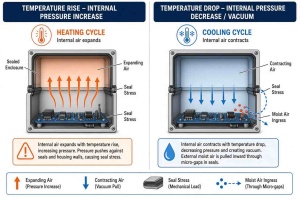
Air and other gases expand when heated and contract when cooled. In a completely sealed housing, even modest temperature swings—common during operation of power electronics, outdoor equipment, or automotive systems—produce measurable pressure differences between the interior and exterior. A rise in temperature increases internal pressure and pushes against gaskets and joints. A drop in temperature creates a partial vacuum that tries to pull external air, moisture, and particles inward through any imperfect seal path.
Altitude changes during shipping or in aerospace and automotive applications amplify the effect. Over repeated cycles, these pressure loads fatigue seals, create micro-gaps, and open pathways for contaminants. The result is often gradual moisture accumulation, corrosion of contacts, optical fogging in displays or lighting, or premature failure of sensitive components.
Consequences of Unmanaged Pressure Changes
When pressure is not equalized, several failure modes become more likely. Seal stress increases the chance of permanent deformation or cracking. Moisture that enters during vacuum phases can condense on cooler internal surfaces once temperatures stabilize, leading to electrical leakage, corrosion, or reduced optical performance. In extreme cases, the pressure differential itself can deform thin walls or displace internal components. Field reliability data from electronics, automotive, and outdoor equipment consistently show that unmanaged pressure differentials contribute to higher warranty claims and shorter service life.
Traditional responses such as thicker gaskets or more rigid housings only partially mitigate the problem and often increase cost and weight. Fully hermetic designs can eliminate exchange but cannot accommodate large thermal or altitude cycles without risking structural damage.
How Protective Vents Achieve Reliable Pressure Equalization
Protective vents based on expanded polytetrafluoroethylene (ePTFE) membranes provide a controlled pathway for air and water vapor while blocking liquid water and solid particles. The microporous structure of ePTFE allows rapid gas exchange that keeps internal and external pressures nearly balanced. Because the membrane is hydrophobic, liquid water beads on the surface rather than penetrating, enabling the enclosure to maintain high ingress-protection ratings such as IP67, IP68, or IP69K when the vent is correctly specified and installed.
During heating cycles, expanding internal air exits through the membrane. During cooling cycles, external air enters gradually through the same path instead of forcing its way through compromised seals. The continuous equalization reduces mechanical stress on gaskets and housing interfaces while limiting the volume of moist air that can be drawn in at any single moment. Residual moisture that does enter can also exit as vapor, helping keep the internal environment drier over time.
Technical Considerations for Effective Vent Selection
Successful pressure equalization depends on matching vent airflow capacity to the free internal volume of the enclosure and the expected rate of temperature or altitude change. Membrane pore size, thickness, and supporting structure determine both the air-flow rate and the water-entry pressure. Additional factors include chemical resistance to oils or cleaning agents, UV stability for outdoor exposure, and vibration durability for mobile or industrial applications.
Installation location, orientation relative to water flow, and surface preparation all influence long-term performance. Engineers typically validate designs through thermal cycling, humidity, and immersion tests that simulate real service conditions.
Spider(Xiamen) Technology Co., Ltd., established in 2016, has focused for more than a decade on ePTFE membranes and high-performance protective venting solutions. The company supplies vents rated to IP67, IP68, and IP69K for electronics, automotive, renewable energy, outdoor equipment, and medical device applications. Its polymer materials research team of master’s and doctoral engineers invests 5 % to 20 % of annual revenue in ongoing material and product development. Quality systems include ISO 9001 and IATF 16949 certifications, supported by third-party reports covering SGS, CE, UL, PFOA-Free, RoHS, and REACH compliance. Products serve more than 1 000 enterprises across Europe, the United States, Germany, Korea, Japan, India, Russia, Turkey, and other markets.
Practical Benefits Across Industries
In sealed electronic products, reliable pressure equalization improves optical clarity in displays and lighting, reduces corrosion risk on circuit boards and connectors, and extends gasket life. Automotive sensor housings, LED modules, outdoor telecom enclosures, and industrial control boxes all benefit from lower internal stress and more stable environmental conditions. The same principle applies to battery packs, medical diagnostic equipment, and portable instrumentation where moisture control and long-term reliability are critical.
By allowing the enclosure to “breathe” in a controlled manner, protective vents convert a source of mechanical and environmental stress into a managed, predictable process.
Implementing Pressure Equalization in Product Design
Design teams should evaluate enclosure volume, expected thermal profiles, and environmental exposure early in the development cycle. Prototype testing under representative temperature and humidity cycles remains the most reliable way to confirm that a chosen vent maintains both pressure balance and the required ingress protection. Custom membrane formulations and housing interfaces can be developed when standard formats do not meet packaging or performance constraints.
Technical consultation on volume calculations, airflow requirements, and material compatibility is available. Inquiries may be directed to weitaiyan@spider-amoy.com.
Pressure equalization is not an optional accessory for sealed electronic products; it is a direct response to the physics of temperature and altitude change. Unmanaged pressure differentials stress seals, invite moisture, and reduce reliability. ePTFE-based protective vents solve the problem by enabling continuous, selective gas exchange while preserving high levels of protection against liquids and particles. When correctly specified, they deliver measurable improvements in durability and field performance.
Spider(Xiamen) Technology Co., Ltd. continues to apply more than ten years of specialized experience in ePTFE membrane technology to these challenges, guided by the principle that integrity builds quality and innovation leads the future. For discussion of specific enclosure designs or customized vent solutions, contact weitaiyan@spider-amoy.com.
By SST R&D Engineering Team, Spider(Xiamen) Technology Co., Ltd.