
Automotive lighting systems—especially modern LED headlights, daytime running lights, and taillights—operate in demanding environments. Rapid temperature swings, high humidity, road spray, and pressure changes routinely create internal condensation. This moisture reduces light output, promotes corrosion, and can lead to premature failure or safety concerns. Traditional sealed designs often cannot cope with the resulting pressure differentials. ePTFE vent membranes provide a proven engineering solution that equalizes pressure, blocks liquid water, and supports IP68-level protection while eliminating fogging.
Why Condensation Forms in Automotive Lighting
When a headlight assembly heats up during operation, internal air expands. Upon cooling or during altitude changes, the air contracts and creates a partial vacuum. Without a controlled breathing path, external moist air is drawn past imperfect seals or gaskets. Once inside, water vapor condenses on cooler lens surfaces, producing the familiar fogging effect. In extreme cases, liquid water accumulates, accelerating corrosion of reflectors, drivers, and connectors.
Sealed plastic housings and adhesive joints alone cannot fully prevent this cycle under real-world thermal and environmental loads. The result is reduced photometric performance, warranty claims, and potential non-compliance with durability requirements.
How ePTFE Vent Membranes Solve the Problem
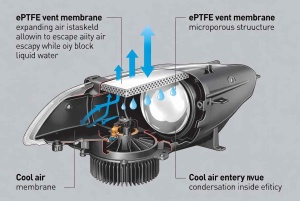
An ePTFE (expanded polytetrafluoroethylene) vent membrane consists of a microporous structure with interconnected pores typically in the sub-micron to low-micron range. These pores allow air and water vapor to pass freely while the inherent hydrophobicity of the material, often enhanced by oleophobic treatments, prevents liquid water ingress under normal and elevated hydrostatic pressures.
In an automotive lighting application the membrane acts as a pressure-equalization port:
- During heat-up, expanding air exits rapidly through the membrane.
- During cool-down or pressure drop, filtered ambient air re-enters without carrying liquid water or dust.
- Continuous vapor transmission helps dry residual moisture that may have entered during assembly or previous exposure.
Because the membrane maintains a high liquid entry pressure, the housing can achieve IP67 or IP68 ratings when the vent is correctly sized and integrated. This combination of breathability and waterproofing addresses the root cause of condensation rather than merely masking symptoms.
Achieving Reliable IP68 Protection
IP68 requires protection against continuous immersion under specified conditions. For lighting assemblies this typically means the vent membrane and its mounting interface must withstand prolonged water exposure while still permitting sufficient airflow for pressure equalization. Key membrane attributes include:
- High water entry pressure (often several meters of water column)
- Adequate air-flow rate at low differential pressure to prevent seal stress
- Chemical resistance to road salts, oils, detergents, and cleaning agents
- Thermal stability across the automotive temperature range (commonly –40 °C to +125 °C or higher near LED heat sources)
- UV and long-term environmental durability
When these characteristics are matched to the housing volume, expected thermal cycles, and mounting method (adhesive, snap-fit, screw-in, or ultrasonic weld), the complete assembly can consistently meet IP68 requirements while remaining free of condensation under normal operating conditions.
Design and Selection Considerations for Lighting Engineers
Successful integration requires attention to several practical factors:
- Air-flow capacity versus enclosure volume and maximum temperature rise.
- Location of the vent to avoid direct high-pressure spray or standing water.
- Compatibility of the adhesive or mechanical attachment with the housing material (PC, PBT, PP, etc.).
- Oleophobic treatment level if exposure to low-surface-tension fluids is expected.
- Validation under combined thermal, humidity, and vibration profiles typical of automotive qualification.
Spider(Xiamen) Technology Co., Ltd. has supplied ePTFE protective vents for automotive lighting and related applications since 2016. Our materials R&D team, staffed by polymer specialists at master’s and doctoral levels, continuously refines pore structure, surface treatments, and conversion processes. The company maintains IATF 16949 and ISO 9001 certifications and routinely provides third-party test data (SGS, RoHS, REACH, PFOA-Free) to support automotive qualification. Annual R&D investment of 5 %–20 % of revenue focuses on improving membrane durability and airflow consistency under real vehicle conditions.
Practical Benefits in Production Vehicles
Properly specified ePTFE vents deliver measurable improvements:
- Elimination or strong reduction of lens fogging across thermal cycles
- Maintained photometric performance and beam pattern integrity
- Extended service life of LED modules, drivers, and connectors
- Reduced warranty exposure related to moisture ingress
- Design freedom to use lighter or more complex housing geometries without over-engineering secondary seals
These advantages apply equally to passenger-car headlights, commercial-vehicle lighting, and emerging high-power LED systems in electric vehicles.
Condensation in automotive lighting is fundamentally a pressure-management and moisture-control problem. ePTFE vent membranes solve it by providing continuous, selective gas exchange while preserving a high level of liquid and particulate protection up to IP68. When membrane properties are matched to the specific thermal, chemical, and mechanical demands of the lighting assembly, reliable field performance becomes achievable.
Engineers evaluating or specifying vents for new lighting programs can request application-specific airflow data, chemical-resistance information, and sample configurations. Technical inquiries and customization requests may be directed to weitaiyan@spider-amoy.com.
By SST R&D Engineering Team, Spider(Xiamen) Technology Co., Ltd.