
Automotive headlights and taillights operate in one of the most demanding micro-environments on a vehicle. Rapid temperature swings, high humidity, road spray, pressure changes from altitude or speed, and continuous vibration all act on sealed optical assemblies. Without controlled pressure equalization and moisture management, condensation forms on lenses, seals degrade, and long-term optical performance suffers. Vent membranes specifically engineered for lighting applications address these issues by allowing air exchange while blocking liquid water and contaminants.
Why Automotive Lighting Needs Vent Membranes
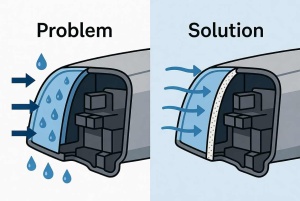
Modern headlight and taillight housings are tightly sealed to meet dust and water protection targets. This sealing creates a closed volume of air. When the lamp is switched on, internal temperature rises quickly; when switched off or exposed to cold ambient air or rain, temperature drops. The resulting pressure differential tries to equalize through any available path. If the only paths are imperfect seals or gaskets, moisture-laden air is drawn in and condensation appears on the inner lens surface.
Repeated pressure cycling also stresses plastic housings, lens bonds, and connector seals. Over time this can lead to reduced sealing integrity, water intrusion, and premature failure. A properly selected vent membrane provides a controlled, high-reliability path for air while maintaining the required ingress protection level.
Common Challenges in Headlights and Taillights
Lighting assemblies face several concurrent stresses:
- Rapid internal heating from LED or halogen sources followed by fast cooling
- High humidity and direct water spray from road conditions
- Temperature extremes ranging from below –40 °C to above 100 °C near the light source
- UV exposure, vibration, and chemical attack from cleaning agents or road salts
- Strict requirements for optical clarity and long service life
Condensation is the most visible symptom, but the underlying problem is unmanaged pressure differential combined with moisture ingress. Traditional solutions such as simple holes or low-performance filters often fail to balance air flow with reliable waterproofing under real driving conditions.
How ePTFE Vent Membranes Address These Challenges
Expanded polytetrafluoroethylene (ePTFE) membranes provide the necessary combination of properties. Their microporous structure allows rapid diffusion of air and water vapor while the hydrophobic nature of PTFE and the small pore size prevent liquid water penetration under normal operating pressures.
In lighting applications the membrane enables:
- Fast pressure equalization during temperature cycling, reducing stress on seals and housings
- Outward diffusion of internal moisture vapor, lowering the likelihood of condensation
- Reliable barrier against liquid water, dust, and many road contaminants
- Compatibility with the thermal and chemical environment of headlight and taillight assemblies
When the membrane is correctly integrated into a vent housing (adhesive, snap-fit, or weldable designs), the complete assembly can meet the ingress protection levels typically required for exterior lighting, commonly IP67 or higher depending on the specific vehicle specification.
Key Performance Requirements for Lighting Applications
Engineers selecting vent membranes for headlights and taillights typically evaluate:
- Air-flow rate sufficient for the internal volume and expected temperature change rate
- Water-entry pressure high enough to withstand high-pressure wash and road spray
- Temperature resistance covering both cold-start and high-heat operating conditions
- UV and chemical stability for exterior exposure
- Mechanical robustness under continuous vibration
- Long-term consistency of air flow and waterproof performance
Oleophobic treatments are often specified to improve resistance to oils and certain cleaning fluids without significantly reducing breathability.
Design and Installation Considerations
The membrane alone does not determine system performance. Housing design, mounting method, location on the lamp assembly, and protection from direct mechanical damage all influence results. Common best practices include:
- Positioning the vent in a location that avoids direct high-pressure spray where possible
- Ensuring the membrane is fully supported and sealed to the housing
- Matching vent size and air-flow capacity to the internal free volume of the headlight or taillight
- Validating the complete assembly under relevant automotive test protocols (thermal cycling, water spray, dust, vibration)
Spider(Xiamen) Technology Co., Ltd. has developed ePTFE protective vent solutions for automotive lighting since 2016. The company’s polymer materials R&D team focuses on membrane grades and vent constructions that meet the combined demands of pressure equalization, waterproofing, and long-term durability in exterior lighting environments. Products are supported by ISO 9001 and IATF 16949 quality systems and can be supplied with relevant third-party test documentation when required.
Selecting the Right Vent for Automotive Lighting
There is no universal vent for every headlight or taillight design. Selection depends on internal volume, expected thermal profile, mounting constraints, target IP rating, and vehicle-specific environmental requirements. Early involvement of the vent supplier during the design phase allows membrane air-flow, water-entry pressure, and housing geometry to be matched to the application, reducing the risk of condensation issues later in validation or field use.
For technical discussion of vent membrane options for headlight and taillight applications, including air-flow data, IP performance, and mounting configurations, contact weitaiyan@spider-amoy.com.
By SST R&D Engineering Team, Spider(Xiamen) Technology Co., Ltd.