
Automotive headlight assemblies must withstand extreme environmental stresses while maintaining clear visibility and long-term reliability. One of the most critical yet often overlooked components is the headlight vent. This article compares ePTFE-based venting solutions with traditional materials, explaining why material selection directly impacts fogging, pressure management, water ingress, and overall service life.
The Hidden Challenges in Headlight Venting
Headlight housings are not completely sealed. Temperature fluctuations from operation, sunlight exposure, and environmental changes cause internal air pressure to rise and fall. Without proper venting, this pressure differential can damage seals, deform plastic housings, or draw in moist air that condenses into fog on the lens.
Traditional venting solutions — such as simple rubber plugs, basic non-woven fabrics, felt pads, or coarse foam filters — often fail to balance breathability with protection. Many allow gradual water or dust ingress over time, especially under road spray, car washes, or prolonged humidity. Others restrict airflow too much, leading to pressure buildup and accelerated component degradation.
Limitations of Traditional Venting Materials
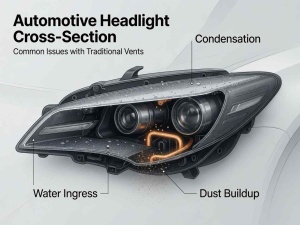
Common traditional approaches present several recurring issues in real-world automotive use:
- Limited breathability: Low air permeability restricts pressure equalization, increasing the risk of housing stress and seal failure.
- Inconsistent water resistance: Materials may initially block water but degrade under UV exposure, temperature cycling, or repeated pressure changes.
- Dust and contaminant accumulation: Larger pore structures or fibrous materials can clog over time, reducing effectiveness and potentially causing optical issues.
- Short service life: Many traditional vents require earlier replacement, raising warranty claims and maintenance costs for vehicle manufacturers and owners.
These limitations become especially problematic in modern LED and adaptive headlights, where higher operating temperatures and more complex optics demand more reliable environmental management.
Why ePTFE Delivers Superior Performance
Expanded polytetrafluoroethylene (ePTFE) is engineered with a unique microporous structure created by controlled stretching of PTFE. This creates billions of interconnected pores that allow rapid air and gas transmission while repelling liquid water and most contaminants due to the material’s inherent hydrophobicity and low surface energy.
In headlight vent applications, ePTFE provides several measurable advantages:
- High air permeability enables fast pressure equalization during rapid temperature changes, reducing mechanical stress on the housing and seals.
- Excellent hydrophobic performance prevents water ingress even under dynamic conditions such as high-pressure washing or heavy rain.
- Fine pore structure effectively blocks dust, road grime, and insects while maintaining consistent airflow over the product’s lifetime.
- Wide temperature stability (typically -40°C to over 150°C) and strong resistance to UV, ozone, and automotive chemicals support long-term durability in under-hood and exterior environments.
- Consistent performance across IP67, IP68, and even IP69K-rated designs when properly integrated into vent assemblies.
These properties allow ePTFE vents to maintain both protective function and pressure management far longer than most traditional alternatives.
Performance Comparison: ePTFE vs Traditional Materials
| Performance Factor | Traditional Materials | ePTFE Membrane Solutions | Practical Impact on Headlights |
|---|---|---|---|
| Air Permeability | Low to moderate | High and consistent | Faster pressure equalization, less housing stress |
| Water Protection | Variable, degrades over time | Excellent and stable | Reduced fogging and water-related failures |
| Dust & Contaminant Resistance | Prone to clogging | Fine pores resist blockage | Longer effective service life |
| Temperature Resistance | Limited in extreme conditions | Wide operating range | Reliable performance in hot/cold climates |
| UV & Chemical Resistance | Often poor long-term | Excellent | Maintains protection over vehicle lifetime |
| Lifecycle Cost | Lower initial cost, higher replacement | Higher initial value, lower total cost | Reduced warranty claims and maintenance |
Engineering Considerations for Headlight Vent Selection
When specifying headlight vents, automotive engineers should evaluate more than initial cost. Key factors include:
- Required airflow rate under expected temperature and altitude differentials.
- Target IP rating and validation under realistic automotive conditions (vibration, thermal shock, pressure cycling).
- Long-term stability of the membrane and housing materials.
- Mounting method compatibility (adhesive, weldable, snap-fit, or threaded) with the headlight housing design.
- Supplier capability to provide consistent quality, test data, and customization support.
Manufacturers with deep experience in polymer membrane technology and automotive quality systems are better positioned to deliver vents that meet both performance targets and production requirements.
The Value of Specialized ePTFE Expertise
Developing reliable headlight venting solutions requires specialized knowledge of membrane science, housing design, and rigorous testing. Companies that have focused on ePTFE protective products for over a decade, maintain dedicated R&D teams, and invest 5–20% of revenue annually in material and process improvement can offer more consistent and application-optimized results.
Spider(Xiamen) Technology Co., Ltd. has specialized in ePTFE membranes and high-performance protective venting since 2016. The company operates under ISO 9001 and IATF 16949 quality systems and has delivered customized solutions supporting IP67, IP68, and IP69K protection to more than 1,000 companies across automotive and other demanding sectors worldwide. Its products are validated through independent testing (including SGS, UL, and others) and are used in applications requiring long-term environmental protection and pressure management.
Conclusion
Choosing between ePTFE and traditional materials for headlight vents is not simply a component decision — it affects optical clarity, housing integrity, warranty performance, and long-term customer satisfaction. ePTFE’s combination of high breathability, reliable water and dust protection, and durability under automotive conditions provides clear technical advantages for modern headlight designs.
For lighting system engineers and procurement teams evaluating venting solutions, understanding these material differences supports more informed decisions that improve both product reliability and total cost of ownership.
By SST R&D Engineering Team, Spider(Xiamen) Technology Co., Ltd.
For technical specifications, application engineering support, or discussion of custom ePTFE headlight venting solutions, contact weitaiyan@spider-amoy.com.