
Electronic control units (ECUs), sensors, and radar modules in modern vehicles and industrial systems operate in sealed housings to achieve high ingress protection. Temperature swings, altitude changes, and rapid pressure differentials still create internal stress, condensation risk, and potential seal failure. Low-profile adhesive ePTFE vents offer a compact materials solution that equalizes pressure and manages moisture vapor while preserving the environmental seal.
Challenges Facing Sealed ECUs, Sensors and Radar Modules
ECUs, environmental sensors, pressure sensors, ultrasonic sensors, and automotive radar units are typically enclosed in plastic or metal housings rated IP67 or higher. During operation or external temperature changes the air volume inside the housing expands or contracts. Without a controlled path for air exchange, pressure differences build across the housing and seals. These differentials can:
- Stress or deform seals and gaskets
- Draw moisture or contaminants past imperfect joints
- Cause condensation on sensitive electronic surfaces or optical windows
- Affect the accuracy of pressure-sensitive or membrane-based sensors
- Reduce long-term reliability of radar modules exposed to road splash, temperature cycling, and vibration
Space constraints on printed circuit boards, module housings, and vehicle packaging further limit the use of traditional mechanical vents or large breathable components. Designers therefore need a thin, discrete solution that can be applied directly to the housing or cover without adding significant height or assembly complexity.
How Low-Profile Adhesive ePTFE Vents Function
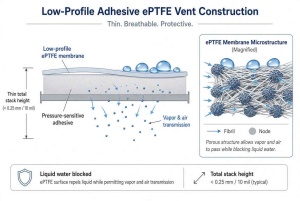
Adhesive ePTFE vents consist of a microporous expanded polytetrafluoroethylene membrane bonded to a pressure-sensitive adhesive layer, typically supplied as thin discs or custom shapes. The membrane’s open-cell fibril-and-node structure permits continuous passage of air and water vapor while its inherent hydrophobicity and small effective pore size block liquid water and most solid particles.
When applied to a flat or slightly contoured surface of an ECU, sensor, or radar housing, the vent allows the internal pressure to track ambient conditions during thermal cycles or altitude changes. Moisture vapor generated by temperature differentials or residual humidity can migrate outward, reducing the likelihood of condensation inside the enclosure. Because the entire assembly is low-profile (often less than 0.5 mm total thickness depending on construction), it fits within tight packaging envelopes and does not interfere with nearby components or optical paths.
The adhesive layer enables rapid, tool-free or automated placement during manufacturing and maintains bond integrity under typical automotive vibration, thermal shock, and chemical exposure when the correct adhesive chemistry is selected for the substrate.
Key Performance Attributes for Electronics Protection
Effective low-profile vents for ECUs, sensors, and radar applications must balance several requirements simultaneously:
- Adequate airflow relative to the free internal volume of the enclosure so that pressure differentials remain within safe limits
- Reliable liquid-water and particulate barrier performance consistent with the target IP rating of the assembly
- Chemical resistance to automotive fluids, cleaning agents, and environmental contaminants
- Stable adhesive performance across the operating temperature range of the module (commonly –40 °C to +105 °C or higher in localized zones)
- Mechanical durability under continuous vibration and repeated thermal cycling
- Minimal contribution to overall package height and mass
These characteristics are verified through material testing, component-level environmental exposure, and system-level validation appropriate to automotive or industrial electronics standards.
Integration Considerations for Design and Manufacturing
Vent location should be chosen on a clean, dry, relatively flat surface away from standing water, direct spray paths, and heat sources that could exceed adhesive limits. Surface energy of the housing material (polycarbonate, PBT, nylon, aluminum, etc.) influences adhesive selection; surface preparation may be required for optimal long-term bond strength. Airflow capacity must be matched to enclosure volume and expected rate of temperature or pressure change—undersized vents leave residual differentials, while oversized openings can become the limiting factor for overall ingress protection if not properly validated.
For radar modules and optical sensors, placement must also avoid interference with electromagnetic performance or optical clarity. In high-volume production the peel-and-stick format supports both manual and automated assembly processes.
Technical Support from Spider(Xiamen) Technology Co., Ltd.
Spider(Xiamen) Technology Co., Ltd. has focused on ePTFE membranes and high-performance protective venting products since 2016. The company operates under ISO 9001 and IATF 16949 quality systems and can provide supporting documentation such as SGS, RoHS, REACH, and PFOA-Free reports. Its polymer materials research team, comprising master’s- and doctoral-level engineers, directs 5 %–20 % of annual revenue into product development and performance refinement. Solutions have been supplied to more than 1 000 enterprises across Europe, the United States, Germany, Korea, Japan, India, Russia, Turkey, and additional markets.
The company’s operating principle—“Integrity builds quality, innovation leads the future”—emphasizes reliable material performance and responsible environmental practice. For projects requiring specific airflow rates, adhesive formulations, or validated performance data for ECU, sensor, or radar housings, technical discussion can begin at weitaiyan@spider-amoy.com.
Sealed electronic modules experience predictable pressure and moisture challenges driven by thermal and environmental cycling. Low-profile adhesive ePTFE vents provide a compact, assembly-friendly method of pressure equalization and vapor management that supports high ingress protection without adding significant height or complexity. Proper selection of membrane airflow, adhesive chemistry, and installation location enables more reliable long-term performance of ECUs, sensors, and radar systems in demanding applications.
By SST R&D Engineering Team, Spider(Xiamen) Technology Co., Ltd.