
Automotive sensors, radar modules, and camera systems operate in some of the most demanding environments of any electronic application. Rapid temperature swings, altitude changes, high-pressure wash-downs, road spray, dust, and chemical exposure all create pressure differentials and contamination risks inside sealed housings. Without effective pressure equalization and environmental protection, these conditions can lead to seal failure, condensation on optical surfaces, signal degradation, or premature component failure.
Protective venting with ePTFE membranes provides a practical engineering solution. The membrane allows air and water vapor to pass while blocking liquid water, dust, and most contaminants, helping maintain internal pressure balance and protecting sensitive optics and electronics.
Why Automotive Sensors, Radar and Cameras Need Protective Venting
Modern vehicles rely on a growing array of cameras, radar, ultrasonic sensors, and related modules for ADAS, parking assistance, surround-view systems, and autonomous driving functions. These components are often mounted externally or in locations exposed to weather, road debris, and thermal cycling from both ambient conditions and nearby heat sources such as engines or exhaust systems.
When a sealed housing experiences a temperature drop, internal air contracts and creates negative pressure. Conversely, heat or altitude changes can generate positive pressure. Either condition stresses gaskets and seals. Over time, this can allow moisture or contaminants to enter. On camera lenses or radar covers, condensation or film formation directly impairs performance. Pressure differentials can also affect the mechanical integrity of the housing or the calibration of precision sensors.
Challenges Specific to Automotive Environments
Automotive applications impose stricter demands than many industrial or consumer electronics uses:
- Wide operating temperature ranges, often from –40 °C to +85 °C or higher near heat sources.
- Exposure to high-pressure, high-temperature water jets (IP69K testing conditions).
- Contact with road salt, oils, fuels, cleaning agents, and other chemicals.
- Continuous vibration and mechanical shock.
- Strict requirements for long-term reliability over the vehicle lifetime, typically 10–15 years or more.
- Limited space and the need for reliable attachment methods that survive assembly processes and service life.
A vent solution must deliver sufficient airflow for rapid pressure equalization while maintaining high liquid entry pressure and chemical resistance under these conditions.
How ePTFE Protective Vents Work in These Applications
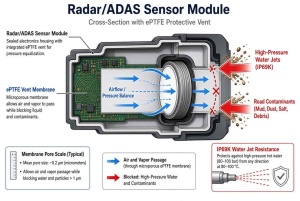
Expanded PTFE membranes consist of a microporous structure of nodes and fibrils. Air and water vapor molecules diffuse through the interconnected pores according to pressure and partial-pressure gradients. Liquid water is resisted by the hydrophobic nature of the polymer and the small pore size, which requires significant pressure to force liquid penetration.
In a typical sensor or camera module, the vent is integrated into the housing wall. When internal pressure rises or falls relative to ambient, air flows through the membrane until equilibrium is restored. Moisture vapor can also exit, reducing the risk of condensation on optical surfaces. Simultaneously, external liquid water, dust, and most particulates are blocked.
When the complete assembly (membrane, attachment interface, and housing) is properly designed and validated, protection ratings of IP67, IP68, and IP69K are achievable. The membrane alone does not guarantee the rating; the full system must be tested under the relevant automotive or IEC standards.
Key Performance Requirements for Automotive Venting
Engineers selecting or specifying vents for sensors, radar, and cameras typically evaluate several parameters:
- Airflow rate at a defined pressure differential (to ensure timely equalization).
- Liquid entry pressure (to resist water ingress under wash or immersion conditions).
- Temperature range and thermal cycling performance.
- Chemical compatibility with expected fluids and contaminants.
- Mechanical robustness of the membrane and support structure under vibration.
- Attachment method reliability (adhesive, snap-fit, screw-in, or weldable) over the product life.
- Oleophobic treatment when exposure to oils or surfactants is expected.
Data sheets normally provide airflow-versus-pressure curves and water entry pressure values measured under controlled conditions. These allow calculation of the required vent size relative to the free air volume of the housing and the expected rate of pressure change.
Design and Installation Considerations
Successful integration depends on matching the vent to the specific module geometry and operating profile. Housing wall thickness, available mounting area, and manufacturing process influence the choice of attachment method. Adhesive vents offer design flexibility and are common for smaller sensor housings. Snap-fit or threaded designs may be preferred where serviceability or higher mechanical retention is required. Weldable options can provide a permanent, robust seal in certain thermoplastic housings.
Location of the vent is also important. Placement should avoid direct high-pressure spray paths when possible and consider drainage so that standing water does not accumulate against the membrane. For optical modules, the vent helps manage internal humidity that could otherwise condense on lenses or covers during temperature transitions.
Validation typically includes thermal cycling, pressure cycling, chemical exposure, and IP testing of the complete assembly rather than the membrane in isolation.
Practical Benefits in Sensor, Radar and Camera Modules
When correctly applied, ePTFE protective vents help:
- Reduce the risk of condensation on camera lenses and radar covers.
- Limit mechanical stress on seals and housing joints caused by pressure differentials.
- Maintain a cleaner internal environment by blocking dust and liquid ingress.
- Support compliance with automotive environmental and sealing requirements.
- Contribute to longer functional life of precision sensing components.
These outcomes depend on proper membrane selection, housing design, and system-level testing rather than on the membrane material alone.
Spider(Xiamen) Technology Co., Ltd. has specialized in ePTFE membranes and protective vent products since 2016. The company operates under ISO 9001 and IATF 16949 quality systems and supplies solutions that support IP67, IP68, and IP69K performance when integrated into validated housings. Application engineering support is available for airflow matching, material compatibility, and attachment method selection.
For technical data, samples, or assistance with automotive sensor, radar, or camera venting requirements, contact the engineering team at weitaiyan@spider-amoy.com.
By SST R&D Engineering Team, Spider(Xiamen) Technology Co., Ltd.