
Many engineers design enclosures to be fully sealed, assuming that a continuous gasket or welded joint will permanently isolate internal components from the external environment. In practice, sealed enclosures still experience pressure differentials that can compromise seals, distort housings, or draw contaminants inward. Protective vents address these physical realities while preserving the intended environmental protection rating.
Pressure Changes Inside a Sealed Enclosure
Temperature is the most common driver of internal pressure change. According to the ideal-gas relationship, a rise in absolute temperature produces a proportional rise in absolute pressure when volume is fixed. A pack or housing that warms from 20 °C to 60 °C can generate a noticeable positive pressure. Cooling produces the opposite effect—a partial vacuum. Altitude changes during transport or operation add further differentials. Even modest pressure differences repeatedly flex seals and can eventually create leak paths.
Without a controlled venting path, the enclosure may equalize pressure through the path of least resistance—usually the gasket interface or a microscopic gap. Each time this occurs, moist air or airborne particles can enter. Over repeated cycles the internal humidity rises, increasing the risk of condensation on electronics, corrosion of contacts, or insulation resistance degradation.
Consequences of Omitting a Protective Vent
Unvented sealed enclosures commonly exhibit several progressive failure modes:
- Housing deformation or stress cracking under sustained pressure or vacuum.
- Gradual seal fatigue that lowers the actual ingress-protection performance below the design rating.
- Moisture accumulation that leads to corrosion, dendrite growth, or intermittent electrical faults.
- Difficulty passing production leak tests or long-term reliability validation.
These issues appear across industries—automotive electronic control units, outdoor lighting, industrial sensors, medical devices, and battery packs—whenever thermal cycling or altitude variation is present.
How Protective Vents Solve the Problem
A protective vent incorporates a microporous membrane, most often expanded polytetrafluoroethylene (ePTFE), mounted in a plastic or metal housing. The membrane’s pore structure permits rapid passage of air and other gases while its low surface energy repels liquid water and blocks most solid particles. When correctly sized, the vent equalizes pressure within seconds to minutes under normal thermal rates of change, keeping the differential across the seals near zero.
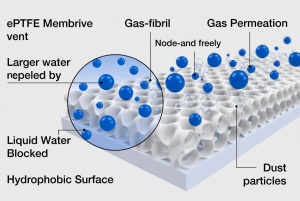
Because the membrane itself forms the primary barrier, the finished assembly can still achieve IP67, IP68, or IP69K ratings when the housing and sealing method are properly designed and validated. Optional oleophobic treatments further improve resistance to oils, coolants, or cleaning fluids that might otherwise wet the membrane surface.
Design and Selection Considerations
Effective application of protective vents requires attention to several practical factors:
- Air-flow capacity matched to free internal volume and expected temperature slew rates.
- Chemical compatibility with the fluids and atmospheres the product will encounter.
- Mechanical robustness under vibration, shock, and thermal cycling.
- Integration method (adhesive, ultrasonic weld, snap-fit, or threaded) compatible with the enclosure material and assembly process.
- Long-term stability of hydrophobic and oleophobic properties after environmental exposure.
Undersized vents lag behind rapid pressure changes; oversized or unprotected vents can become mechanical weak points. Prototype testing under combined thermal, humidity, and pressure profiles remains the most reliable verification method.
Application Experience Across Industries
Spider(Xiamen) Technology Co., Ltd. has specialized in ePTFE membranes and protective venting components since 2016. The company’s polymer-materials research team, staffed by master’s- and doctoral-level engineers, directs 5 %–20 % of annual revenue into membrane formulation, process development, and application-specific housing design. Products are manufactured under ISO 9001 and IATF 16949 systems and are supported by third-party verification including SGS, CE, UL, RoHS, REACH, and PFOA-Free reports where required.
These vents are supplied to customers in electronics, automotive, new-energy, outdoor equipment, and medical-device sectors across Europe, the United States, Germany, Korea, Japan, India, Russia, Turkey, and other markets. The same underlying physical principles—pressure equalization combined with reliable barrier performance—apply whether the enclosure houses an ECU, a sensor, a lighting module, or a battery pack.
Practical Guidance for Designers
When evaluating whether a sealed enclosure needs a protective vent, quantify the expected temperature range, altitude exposure, and free internal volume. Calculate approximate pressure differentials and compare them with the mechanical limits of the housing and seals. Request measured air-flow versus differential-pressure data, confirmed IP-test methods, and material-compatibility statements for the specific application environment.
For technical discussion of membrane selection, custom geometries, or validation support, contact the engineering team at weitaiyan@spider-amoy.com.
By SST R&D Engineering Team, Spider(Xiamen) Technology Co., Ltd.