
New energy vehicle (NEV) battery packs and electronic control systems operate as sealed enclosures under demanding thermal, altitude, and environmental conditions. Rapid temperature changes during charging, discharging, or ambient shifts create internal pressure differentials. Without controlled pressure equalization, these differentials can deform housings, compromise seals, draw in moisture, and accelerate component degradation. Seal Protection Vents based on ePTFE membranes provide a reliable solution by allowing continuous air exchange while blocking liquid water, dust, and contaminants. This article examines the underlying pressure challenges, the dual-protection mechanism of these vents, and practical considerations for battery pack and electronic control unit (ECU) design.
Pressure Challenges in Battery Packs and Electronic Control Systems
Battery pack housings and high-voltage electronic enclosures are designed as closed systems to meet strict ingress protection requirements, typically IP67 or IP68. Inside these enclosures, air volume expands when temperature rises and contracts when temperature falls. The resulting pressure difference relative to the external atmosphere acts on the housing walls, seals, and interfaces.
In the absence of a controlled air path, several issues appear. Housings may experience measurable deflection or permanent deformation. Gaskets and connector seals can be stressed or partially dislodged. During cooling phases a partial vacuum forms, increasing the risk that moist air or liquid water is drawn through the weakest points. Condensation then forms on cooler internal surfaces, raising the possibility of corrosion, reduced insulation resistance, or long-term reliability problems for sensors, busbars, and control electronics.
Altitude changes during vehicle transport or operation in mountainous regions produce additional pressure differentials. Electronic control units, battery management system housings, and power electronics enclosures face the same physics on a smaller scale. Effective pressure management is therefore a fundamental design requirement rather than an optional feature.
How Seal Protection Vents Achieve Pressure Balance
Seal Protection Vents create a selective gas-permeable path through the enclosure wall. The functional core is a microporous ePTFE membrane. Air molecules pass freely through the membrane structure, equalizing internal and external pressure almost immediately. Liquid water is blocked by the hydrophobic surface chemistry and the geometry of the pores. Most solid contaminants are also excluded.
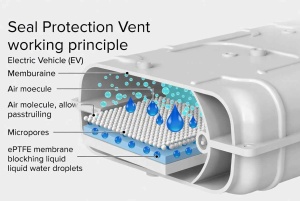
This dual function—pressure equalization combined with liquid barrier performance—addresses the root causes of housing stress and moisture ingress simultaneously. When correctly sized and located, the vent maintains the intended protection rating of the complete assembly while preventing the cyclic loading that would otherwise fatigue seals and housings.
Technical Characteristics Relevant to NEV Applications
For battery packs and electronic control systems the membrane and supporting structure must satisfy several simultaneous requirements:
- Sufficient airflow capacity relative to enclosure volume and expected rates of temperature change
- High water entry pressure compatible with IP67, IP68, or higher system targets
- Resistance to automotive fluids, coolants, and potential battery-related atmospheres
- Stability across the wide temperature range encountered in vehicle operation and thermal management cycles
- Mechanical durability under vibration and shock typical of automotive environments
Spider(Xiamen) Technology Co., Ltd. has focused on ePTFE membrane technology and protective venting solutions since 2016. The company’s polymer materials research team, composed of master’s- and doctoral-level engineers, allocates a significant share of annual revenue (5 %–20 %) to membrane structure optimization, surface treatments, and application-specific validation. Products are developed and produced under ISO 9001 and IATF 16949 quality systems, with supporting test documentation available for SGS, CE, UL, PFOA-Free, RoHS, and REACH requirements. Solutions have been supplied to customers across Europe, the United States, Germany, Korea, Japan, India, and other markets for more than 1,000 companies.
Practical Benefits for Battery Pack and ECU Reliability
When Seal Protection Vents are properly integrated, several engineering outcomes become achievable:
- Reduced cyclic stress on housings and seals, supporting long-term structural integrity
- Lower risk of moisture-related insulation degradation and corrosion inside the enclosure
- Ability to maintain high ingress protection ratings without resorting to overly rigid or complex sealing designs
- Improved consistency of internal environmental conditions for sensors and electronic components
- Simplified validation of environmental sealing during design verification and production testing
These benefits contribute directly to the durability targets expected of modern NEV platforms.
Selection and Integration Considerations
Design engineers should evaluate airflow demand based on free internal volume and the most severe expected temperature or altitude transients. Mounting method (adhesive, snap-fit, screw-in, or weldable) must match the housing material and manufacturing process. Location should avoid direct exposure to high-pressure spray or standing water while remaining accessible for service if required. Chemical compatibility and temperature rating must be confirmed against the specific fluids and thermal profile of the application.
Technical consultation on membrane selection, airflow sizing, or custom configurations for battery packs and electronic control systems can be directed to weitaiyan@spider-amoy.com.
Pressure differentials in sealed NEV battery packs and electronic control enclosures are an inevitable consequence of temperature and altitude changes. Seal Protection Vents using engineered ePTFE membranes provide a controlled, durable solution that equalizes pressure while preserving liquid and particle barriers. When selected and integrated with attention to airflow, chemistry, and mechanical requirements, these vents support housing integrity, moisture control, and overall system reliability.
By SST R&D Engineering Team, Spider(Xiamen) Technology Co., Ltd.