
A fully sealed housing looks like the safest design for an ECU, domain controller, radar sensor, or camera module. In a vehicle it is often the opposite. Temperature cycling, humidity, and pressure change turn a “hermetic” box into a reliability risk. The enclosure must keep liquid water, dust, salt, and oils out. At the same time it must let air and water vapor move. That is the job of a properly specified breathable vent.
Temperature Cycling Creates Pressure That Seals Cannot Ignore
Vehicle electronics see large and rapid temperature swings. Under-hood ECUs and domain controllers sit near heat sources. Exterior radar and camera modules heat and cool with sun load, airflow, and their own power dissipation. Air inside a closed volume expands when the housing warms and contracts when it cools.
The result is a repeating pressure differential across the gasket or weld. Even a few kilopascals, applied over thousands of thermal cycles, fatigue seals, pull them off the mating surface, or create a path for contaminants. Negative pressure after cooldown is especially damaging: it can draw moist air or liquid past a seal that would have held under positive pressure or static conditions. High-pressure wash (IPX9K-type exposure) makes the same mechanism worse if the housing is already under vacuum.
A breathable path equalizes that differential in seconds rather than leaving the seal to absorb it for the life of the vehicle.
Condensation Forms Even When Liquid Water Never Enters
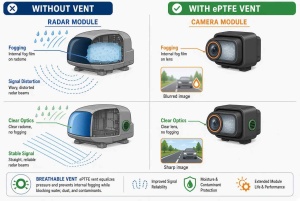
Moisture does not have to leak in as liquid. It enters as vapor through permeation, through imperfect seals during pressure events, or as residual humidity from assembly. When the interior air cools below its dew point, water condenses on the coldest surfaces—often the PCB, connectors, lens, or radar radome.
Condensation causes corrosion on copper traces, dendrite growth, insulation breakdown, and intermittent faults. In optical and radar modules it also creates fogging or a dielectric film that changes signal path or image quality. Once liquid water is present inside, a sealed housing has no way to dry itself. The next heat cycle simply redistributes the moisture.
A microporous membrane that transmits water vapor while blocking liquid water lets the enclosure dry. Internal relative humidity stays closer to the exterior, so dew-point crossings become less frequent and less severe.
Radar and Camera Performance Depends on a Dry, Stable Interior
Millimeter-wave radar for ADAS is sensitive to condensation on or behind the radome and to dimensional or dielectric change inside the housing. Fog or a water film can shift detection range, create false targets, or force a system fault. Camera modules have the same problem on the lens and imager. Both product families are usually mounted outside the cabin, so they see rain, spray, dust, and thermal shock every day.
Domain controllers and ECUs add another constraint: they dissipate more heat in a compact volume and often sit in chemically aggressive locations (oil mist, road salt, washer fluid). Outgassing from plastics and adhesives also accumulates if the housing cannot exchange gas. A vent that only “breathes” under laboratory conditions is not enough; it must keep airflow after vibration, thermal shock, and chemical exposure.
ePTFE Vents Equalize Pressure Without Opening the Enclosure
Expanded PTFE membranes use a node-and-fibril microstructure. Typical pore sizes in this application are on the order of 0.1–0.5 μm. Air and water-vapor molecules pass; liquid water, most oils, and particles do not, provided the membrane is hydrophobic and, where needed, oleophobic, and the assembly has adequate water-entry pressure.
That combination is what allows an enclosure to carry IP67, IP68, or IP69K ratings while still equalizing pressure. The membrane itself is chemically inert and thermally stable across the automotive range. The finished vent—adhesive, snap-fit, screw-in, or weldable—must keep that performance after assembly, paint, and vehicle-level validation.
Spider (Xiamen) Technology Co., Ltd has worked on this class of ePTFE membranes and protective vents since 2016. The work is grounded in polymer-materials R&D rather than in generic sealing parts. A team of master’s- and doctoral-level polymer engineers supports application-specific constructions. The company invests 5%–20% of annual revenue in new membrane and vent development so that airflow, water-entry pressure, chemical resistance, and processability can be balanced for a given housing, not copied from a catalog sheet.
Quality systems include ISO 9001 and IATF 16949. Supporting reports (SGS, CE, UL, PFOA-free, RoHS, REACH) are available when a program requires them. Products are used in electronics, automotive, new-energy, outdoor, and medical applications and have been supplied to customers in Europe, the United States, Germany, Korea, Japan, India, Russia, Turkey, and other markets. The operating idea is straightforward: integrity first, then material improvement—“Integrity Builds Quality, Innovation Leads the Future.”
Selecting a Vent That Matches Automotive Reality
Engineers should treat the vent as a functional component, not a hole cover. Useful specification points include:
- Airflow at a defined differential (enough to equalize the housing volume under the fastest expected temperature ramp).
- Water-entry pressure and IP target (IP67 / IP68 / IP69K as required by location and wash process).
- Temperature range and chemical list (engine fluids, electrolytes, cleaners, UV).
- Installation method compatible with the housing material and process (adhesive for compact camera and radar packages, weldable or snap-fit for higher-volume or higher-temperature ECU housings).
- Validation against thermal shock, vibration, and salt or chemical soak, not only a single IP dunk test.
Placement matters. A vent on a surface that stays wet or that faces a high-pressure jet will see different duty than one on a sheltered side wall. The membrane must remain the limiting path; a blocked or painted-over vent is worse than no vent.
For application review, sample evaluation, or a construction matched to a specific ECU, domain controller, radar, or camera housing, the engineering team can be reached at weitaiyan@spider-amoy.com.
The goal is not a more impressive datasheet. It is a housing that stays dry, stays sealed, and stays within its design pressure for the life of the vehicle.
By SST R&D Engineering Team, Spider(Xiamen) Technology Co., Ltd.